Peer Review – Two

Katie Scragg: A Healthy Mind

Katies digital artefact this semester is A Healthy Mind. A Healthy Mind is currently an Instagram and Tik Tok account where Katie updates her followers about little things, they can do throughout their day to make it better/healthier. I think, having the two platforms is an excellent start and later expanding to a website is a great idea.

Katie currently has a small following of 42 on Instagram and 6 followers on Tik Tok. I think this digital artefact has so much more potential than the audience/feedback already received. Katie looks as though she is posting on a regular basis which is a great start but a suggestion, I have for her would be to maybe have a posting schedule. Maybe 3 Instagram posts a week, on specific days and 2 Tik Tok posts a week on specific days. This way, her followers know which day she will upload and might even entice more of an audience as there will be some structure to her accounts.

Katie speaks about what she will be doing to improve A Healthy Mind, and I think everything she has said is a great idea. I think her idea of establishing an aesthetic will help her more than she realises as it will not only make her account aesthetically pleasing, but it will allow followers or potential followers to see what kind of a person Katie is as well as fit the FIST principle more as she will have a set way of her posts looking. It is never too late to start an aesthetic, especially on Instagram and so my advice to her would be to play with some colour pallets and figure out an aesthetic that suits her and her style. Katie also mentions how she uploaded an outfit image and I think if she posted more outfit images, especially on Instagram, her audience would expand vastly. A lot of users on Instagram, specifically female demographic, go to Instagram for outfit ideas, or even just outfit aesthetics and Katie could easily incorporate this in one of her weekly posts.

I enjoyed watching and reading Katies beta, however I felt the video could have been more engaging with more explanation as to what was going on. I also would have liked to see more of her content throughout the beta as I had to go searching myself to see what her accounts looked like. I think she drew upon background research really well and it made it easy to understand why she is doing this account. Coming out of lockdown, I think this project still has a lot of potential as people are constantly looking for motivation or a way to live a healthier life, it may just be harder to find a niche not being in lockdown anymore.

Tobias Thomas: Tik Tok Account

This semester, Tobias turned his blank personal Tik Tok account into his digital artefact. His digital artefact is aimed at ADHD awareness, University share house students as well as humorous videos for his followers. As a follower of this page, I have to say that Tobias’ content is quite engaging and I find it extremely relatable (even though I don’t live in a share house lol), which is the best way to gain an audience and feedback loop.

At first, it looked like Tobias was editing his videos off the app and then uploading them as a video already done up which I think for Tik Tok is not a good idea. It is more pleasing and better to watch a Tik Tok video that was edited on the application as it fits the screen, and the quality of the video is a lot better. However, I think Tobias picked this up on his own as his most recent uploads are better quality, and it shows it is working as his engagement has risen as well. I am honestly not surprised that his engagement rose as his content is exactly what Tik Tok users go on for, quality and relatable content. I also think Tobias trying to aim his account at ADHD awareness is such a good idea as it is something you don’t really see on social media at all and I think people should learn a lot more about it as it affects more adults than people expect.

In regard to what Tobias could improve on I think he could upload a little more regularly. This way he will be giving his account optimal opportunity to gain more of an audience and feedback loop. Something else is that he could even try using more hashtags and ensure his captions are relating to the video as I know Tik Tok’s algorithm even filters the words used in the captions and in the videos as well.

I enjoyed watching Tobias’ beta video, however it did go over the 3-minute limit. I really enjoyed how he put some of his content at the end of the video as it allowed me to visualise what he was talking about, despite me already being a regular follower of his Tik Tok account. I also think a link to his account would have been good for easy access. Other than that, I really have enjoyed watching this account grow and can’t wait to see what he does with it in the future.

Until Next Time, R
Daily Ruby – Beta

Process Continued (from video)

Continuing on from the attached video, my followers that I have gained over the past few weeks are looking to be around the same age as me and mostly female, this is exactly what I was expecting when starting this account. I also have a couple of other DA’s following me which is so good to see as I think DA’s, especially on the same platform should be following and supporting each other. In order to gain these followers, I have been using relevant sounds, hashtags, key words and following people who I think would be interested in my videos. I have also been making a conscious effort to use this account more often and not just my personal account so that Tik Tok will filter my For Your Page for me, and hopefully put my videos on similar individuals’ pages.

Something that I think has been a positive in this project is my like to views ratio. Although my views are quite low for a Tik Tok account, my likes are staying consistent, especially compared to my views. An example of this is on one of my videos I only got 66 views but on that video, I got 9 likes, whereas on my other videos I am ranging between 10 – 30 likes for 100+ views. The video that got only 66 views was extremely disheartening, especially because I found it to be one, I put a lot of effort into, except I did forget to edit the front and follow the theme as the rest of my account, which could have been where I failed there. I now make a conscious effort to ensure I am sticking to my theme and not forgetting.

Prototype Continued (from video)

I personally started to not want to film my days a lot, and I also felt as though my videos were getting too repetitive, being in lockdown, for my content to be engaging for my audience and it was detrimental to my accounts ability to reach a wider audience. Therefore, as seen with my most recent video I took a different angle, I really enjoyed making the video and my views rose which was such a positive. I will be doing this again a few more times to see what happens to the engagement on my account. I also feel like, only doing the day in my life videos, not only is it repetitive but when I get out of lockdown, I won’t have the time during the day to film a Tik Tok as I usually live quite a busy life, juggling a job, studying a bachelor and a certificate outside of Uni, as well as a social life, I won’t want to be filming constantly.

The new style of video that my account might mainly be, is more aesthetically pleasing videos. Such as, morning routines, night routines, and possibly even a workout routine. This way, there is aesthetically pleasing sounds in the background without my voice and users are able to just simply watch what I am doing. This style of video is a lot shorter, which enables a wider scope and a lot more users to watch the full video and interact with it and it is also way easier for me to upload as I don’t have to sit and voice over at the end. I can just film little parts of what I am doing, edit the cover, and upload it straight away. This then fits into FIST principle way more than my original idea.

Something I could start doing is interacting with more videos of the regular hashtags that I use and also uploading more regularly. I would love to hear any feedback that people have to ensure that my videos are entertaining and reaching their full potential.

Until Next Time, Ruby

Peer Review – One

Charlotte – PierroPerspective

Concept:

PierroPerspective seems to be such a good idea for Charlotte’s digital artefact as she wishes to one day be a professional photographer. The two platforms she has mentioned she will use, Instagram and YouTube, I think, are the best way she can showcase this business for right now. Keeping a regular posting schedule will help gain more of an audience and ensure that Charlotte is consistent with her work to show future employers.

Methodology:

I love the idea of using Instagram reels as I think Instagram is such a great platform and its features, like Instagram reels, have so much potential if the creator is adding their own spin on things. To ensure she is reaching her potential audience and ‘expanding your audience’ as she said in her video, I think Charlotte could use different sounds that are highly trending to ensure her page is making it on the feed of people who are interested in her content. Another suggestion I have is to potentially collaborate with other brands or Digital Artefacts. I am sure there are plenty of students who would love to use her business to expand theirs and she could also use them to expand hers. (I personally would love to collaborate with you). This way, she is reaching a wider audience and doing something different to her account currently.

Utility:

Turning PierroPerspective more into a business rather than a photography account is an extremely smart business decision. When she first begun the page, it was to showcase her photography and videography and to expand on her skills, whereas now it is clear that she wants to build this brand and make it on her own, career wise. I think this is amazing. In order to ensure her business flourishes, I think that if she were to collaborate with other brands/businesses it could potentially be to build her name up, but I also think she could reach out to individuals who want to eventually be an influencer (Arabella Atsas is coming to mind). I know, and she has been so open, about how she is slowly growing her Instagram to become an influencer one day, and if Charlotte were to collab with someone like Arabella then you both are gaining something from the experience. Just a suggestion!

Pitch:

I really enjoyed watching Charlotte’s pitch, and I loved how she incorporated her already made Instagram page and YouTube channel. However, I would have loved to see her photos and examples of her videography closer to see what she has to offer. Whether that of been in the video or in the accompanying blog post.

Tori – Shop with Tori

Concept:

‘Shop with Tori’ is something that is so relevant to today’s society and something that the media is missing. As Tori is someone who just loves to online shop, to share her views on what she purchases is such a smart idea, I wish I had come up with it. I think using Tik Tok will be a great start for this project as she will be able to reach a wide audience and using hashtags and popular sounds, Tori will be able to reach the exact audience she is hoping for.

Methodology:

Tori seems unsure about how she should post her videos and my personal suggestion to her would be to post a mix of all. I think if she were to have some videos that were raw live reactions of the clothing items she bought, or the recipes and trends she is buying then her audience will feel so much more engaged with her content. But, if Tori were to post Anna Paul style daily vlogs then I think doing a voice over would be the way to go. I think having this mix of all style of videos will ensure her Tik Tok account reaches its full potential. Tori also asked about whether she should have an accompanying Instagram account and my answer is simple, absolutely yes! I think she should create a whole new account and not use her old gaming account as her audience is completely different to before. Having an Instagram account will help her keep her audience more up to date with certain topics. She can also use features such as stories, polls and question boxes to ask her audience what they want to see more of.

Utility:

Tori will be helping so many people save money through this idea. The reason I say this is because we don’t really have anyone in our geographic region who posts videos or has an account like Tori wishes to create, therefore, I think this account has so much potential. Lockdown and the pandemic have affected each one of us, but something that has grown immensely has been online shopping.

Pitch:

I really enjoyed watching Tori’s pitch and I like how she still wants to incorporate her old ideas into this new idea. I also thought it was very clever how she pitched her idea and ended with questions as it keeps her audience engaged from the start. I thought she gave enough background information on the matter for everyone to understand why she is doing what she is doing. All in all, I am so excited to follow along ‘Shop with Tori’ and see what she comes up with.

Until Next Time, R

Daily Ruby – Pitch

video pitch

I have created Daily Ruby to share the life that I live.

Social media is described by many as a ‘highlights reel’ of one’s life. This creates unrealistic ideals of individuals lives and creates users and followers to doubt themselves and their lives in comparison to what they see online. I know it is very far out of my reach to minimise this doubt in social media users, however, I will try my hardest to at least make one individual see that not everything in life is a ‘highlights reel’. Users are very rarely seeing what happens behind the scenes of the people they follow online and ‘day in my life’ videos help to see that not everything is aesthetically pleasing and perfectly glammed.

I asked twitter if people are interested in ‘day in my life’ (linked is an example of this type of video) Tik Tok videos and although only 7 people voted, only one of those seven people responded ‘no’.

Although an extremely small start, this is showing me that there are people who are interested in this type of content which is where gaining an audience begins.

I have chosen to begin Daily Ruby on Tik Tok as I find it the most relevant and greatest way to achieve my goal and solve this problem. Tik Tok has been a highly trending social media platform for over a year now and it is a great way to ensure your content is reaching all types of individuals. With the use of hashtags and different sounds, the application will filter who it shows your content too to ensure you are receiving the best engagement possible for your videos. On this platform, all it takes is for one video to go ‘viral’ or do well with views, likes and comments for your account to reach an intended audience. These are the reasons I have chosen Tik Tok.

As said in the above video, these Tik Toks will be one minute in length and contain snippets of my day. Over the top of this video, I will voice record what I am doing to keep my audience engaged and explain my day.

These Tik Toks fit into Ted’s FIST analogy. They are a very easy and quick watch and are also inexpensive, simply as it does not cost me anything to film parts of my day. They are extremely simple which is one of the main reasons why I have chosen this idea. They are tiny as they are only one minute in length, and with days that I am not super busy, they probably won’t even reach the full minute mark.

I am still unsure as to where I want this degree to take me, career wise, but what I do know in my future career is that I want it to be creative, something different every day and a versatile job where I am not sitting in an office 9-5, five days a week.

In the future Daily Ruby has the potential to expand to other platforms, for longer videos; YouTube, for regular updates and more motivation; Instagram. But, for right now, my smaller goal is to maintain a good and realistic posting schedule and to build a small audience on Tik Tok for Daily Ruby.

Until Next Time, Ruby

Have You Met Me?

This semester, Hunter, Casey, Seth, Danielle, Tobias, Jett, and I have been working on our group tabletop game – ‘Have You Met Me?’ This game is a dating inspired card game with a deck of 130 cards and is a 4-10 player game. Surprisingly enough, the first game genre/theme we discussed about, we ended up staying with throughout the entirety of completing the game rules, mechanics, and design processes.

During the first week of designing the game, Jett was the one who sparked the idea in everyone’s minds. He spoke about the Netflix show ‘Are You the One?’, where each ‘player’ or ‘contestant’ on the show was there to find their perfect match and test if they could get it right. Reality TV at its finest if you ask me. From this, as a group we all started to come up with masses of ideas of what our game would include. We all, however, had the same end goal, we should make it a dating inspired game where players are to ‘find their perfect match’. From the get-go of iterating our project, we wanted players to join the magic circle with the intention of corresponding personality traits to find their perfect match.

First on our agenda, to just get this part out of the way, was coming up with the name of our game. We all just sort of stared blankly, so I turned to Hunter and went “Go, think of a name.” Then, he just goes, “Haaaaaave you met me?” Ever since, the name stuck, and it fit quite perfectly.

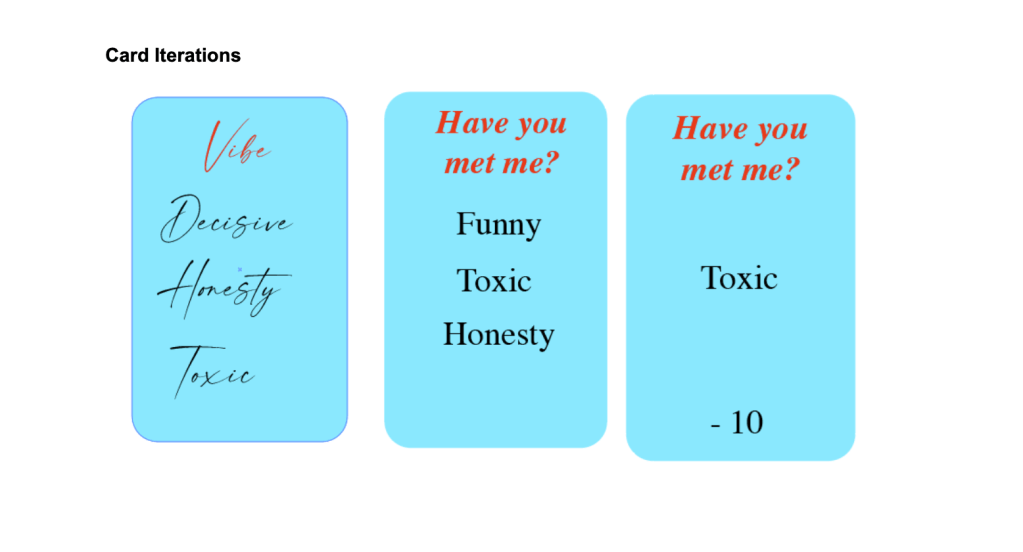
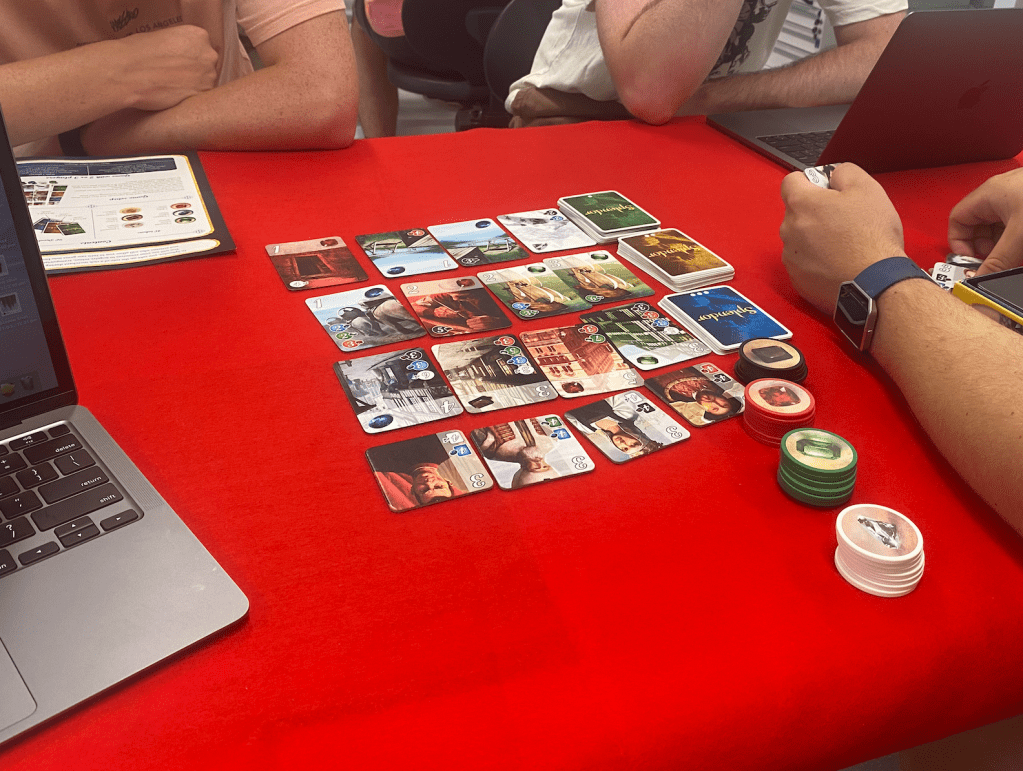
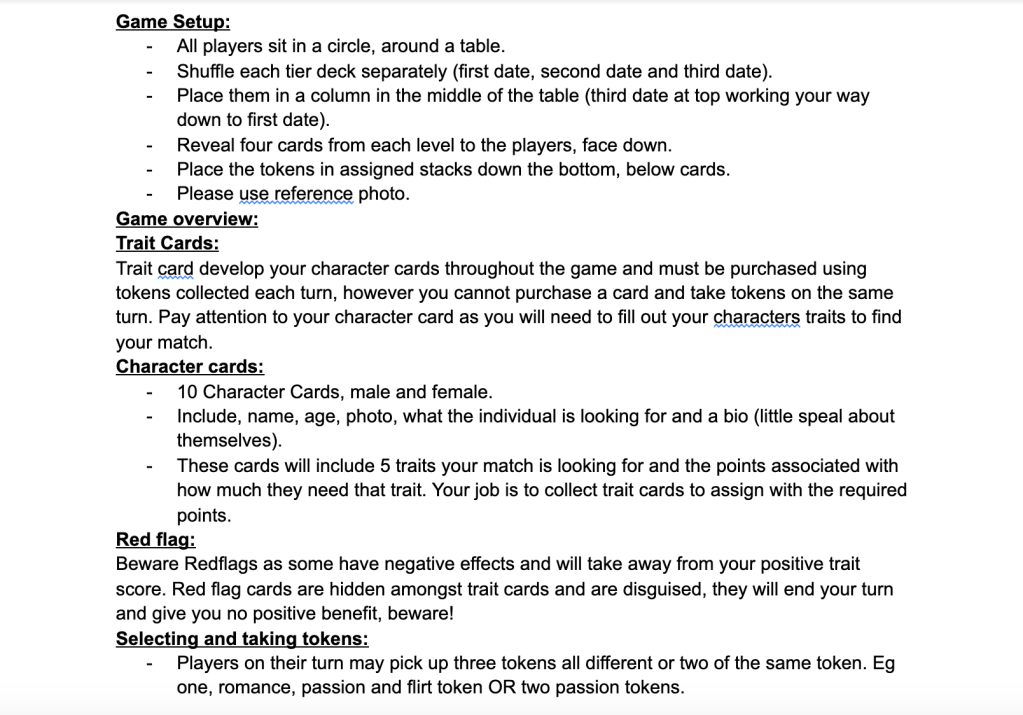
As a group we had quite a long iteration process of how we wanted the mechanics of the game to work, what cards were involved and how they were all going to be designed. We had a light bulb moment and firstly came up with the idea of vibe cards and red flag cards. The vibe cards were a way of gaining in this game and the red flag cards were a way to set back players and ensure the game is bit more fun to be played. As we were writing the different personality traits on the vibe and red flag cards, we saw that calling them vibe cards didn’t fit the game right, so that’s when we came up with the name trait cards, as that is exactly what they are. They are the cards in our deck that hold the traits that you need to gain to win. We all agreed to making sure the vibe cards and red flag cards looked the same on the back so that players didn’t know if they were getting a good, or bad card. This was to have an element of surprise and risk in the game and to keep it interesting. We also came up with the idea of character cards so that each individual player had a person that they were playing the game as. These character cards basically rule how each player plays the game. Through these cards we had come up with, we originally wanted our game to be played/set out like Splendour, which we had previously played in class. Therefore, we added the element of using Tokens in our game to gain vibe cards and red flag cards.

original planning of game mechanics
original design of cards

Our first meeting as a group ran quite smoothly and this is where we came up with everyone’s individual roles in the team. We decided the boys would figure out what traits the trait cards and red flag cards needed, and the girls were doing the design of the cards. I personally took charge of the character cards. I really wanted the design of the character cards to reflect a Tinder profile, as that is a very popular app amongst young adults our age. I felt as though the design of the card replicates this quite well. An issue however that I did come across while making the character cards was the skin colour of each player. I would have liked diversity among the characters but every ‘human looking’ avatar/character generator did not have the option to change skin colours. That is probably one of the only things I would change about our cards.

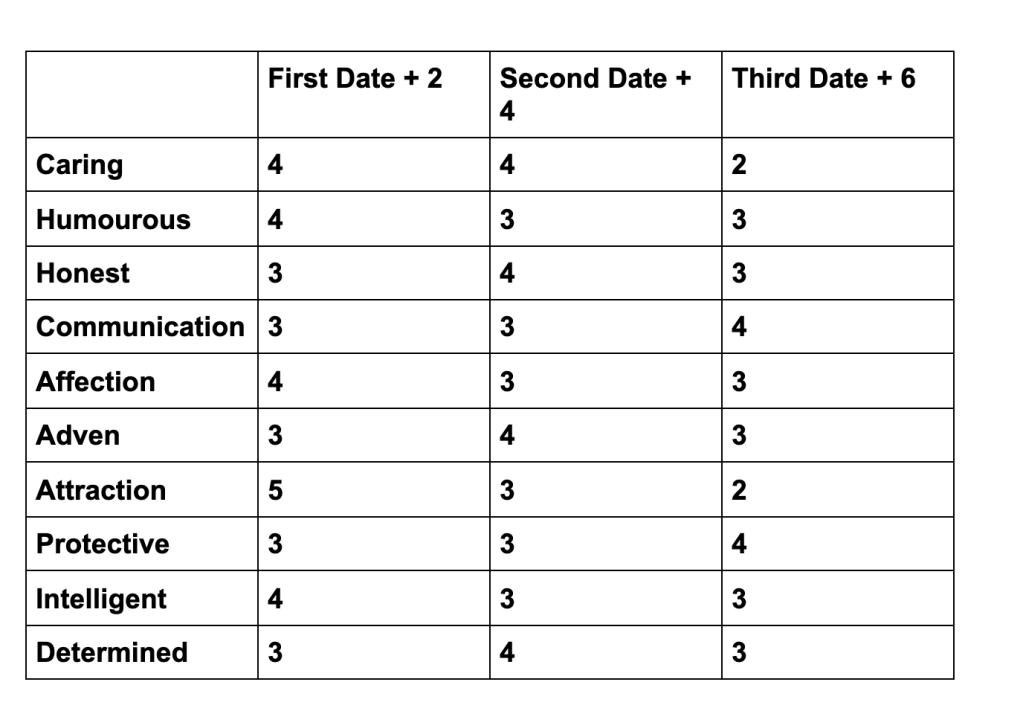
How we distributed the cards and different traits

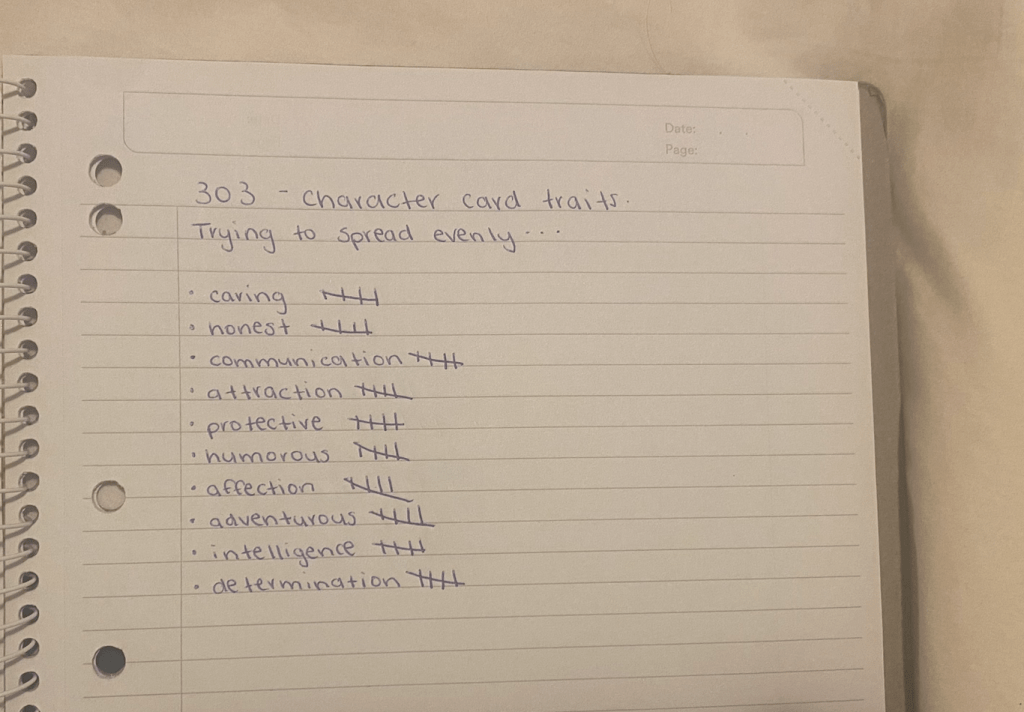
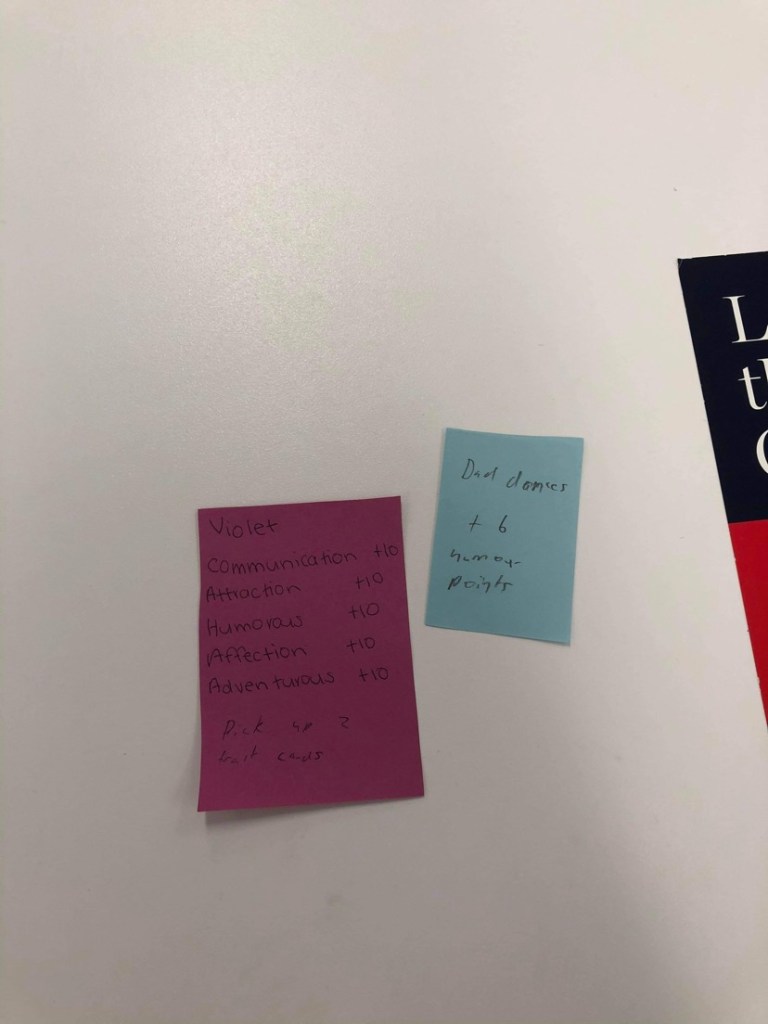
With the character cards (link should take you to the site I used and the mock ups of the character cards), the original ones were to have the traits players needed to collect and a witty bio at the bottom to keep the game light-hearted and to get to know each character a bit better. However, our very first, very rough, play test was done, we realised the game was kind of boring and repetitive, which is where we decided each character to have a specific ‘power’ that they can use once in the game. We ended up coming up with five different powers, so each boy contracted one and each girl received the same as a boy, to keep the game fair. Hunter and I sat together to come up with these powers and ensure each one was just as an advantage as the others. Therefore, we replaced the bio on the character cards with what each character could do during the game. With this rule however, once Hunter play tested the game once again with his roommates, he said that the powers should be able to be used more than once, which is why now players can use their powers 3 times during a game.

The way I organised to evenly distribute traits on character cards

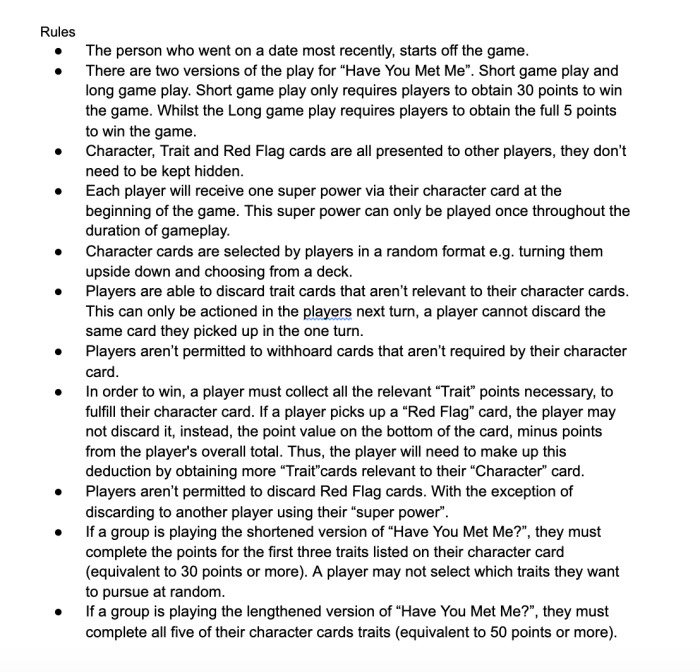
During other meetings our group had, the iteration process changed immensely. The first mechanic we changed were the tokens, we decided it was too much for the game, so we removed them. At one point we had dice in there to determine which tier the player would be choosing a card from. However, we landed on all the cards in one pile, and when it is your turn and you pick up a card, if you need that card, you can keep it, if you don’t then you can place it in the discard pile. Although, you can’t discard red flag cards or keep cards you don’t need to ‘cancel out’ red flag cards. Then we also came up with the two different versions of the game, the longer version and the shorter version. We decided that if players wanted a shorter game they could use only the first three traits listed on their character cards to have 30 points to win, or if they wanted a longer game they could use the entire card and gain 50 points to win.

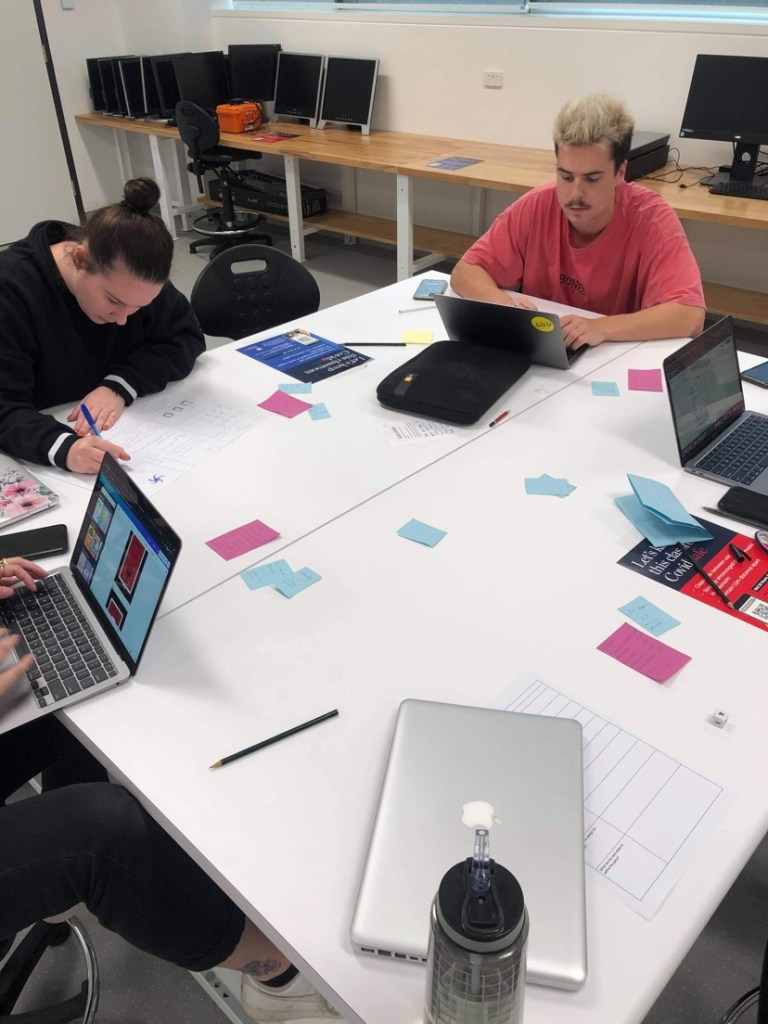
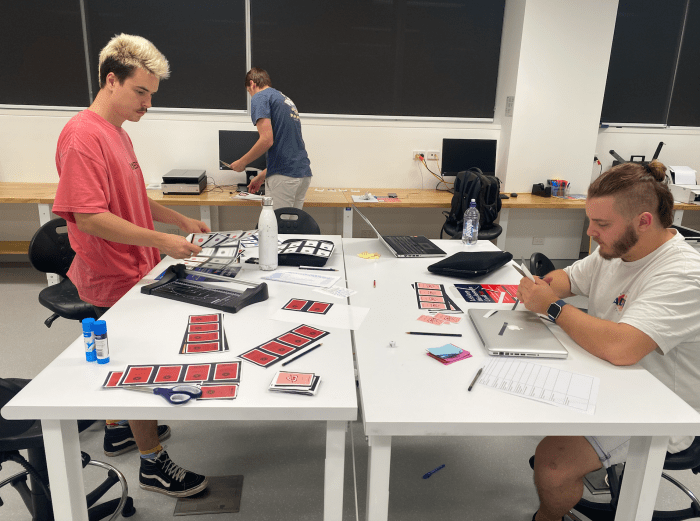
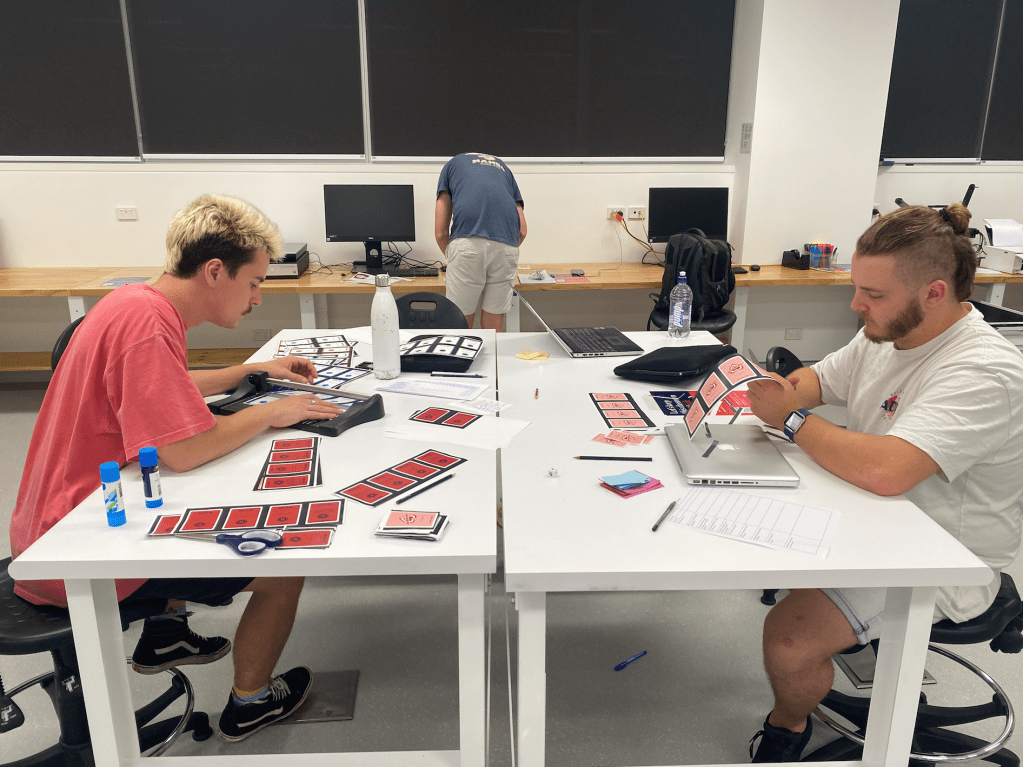
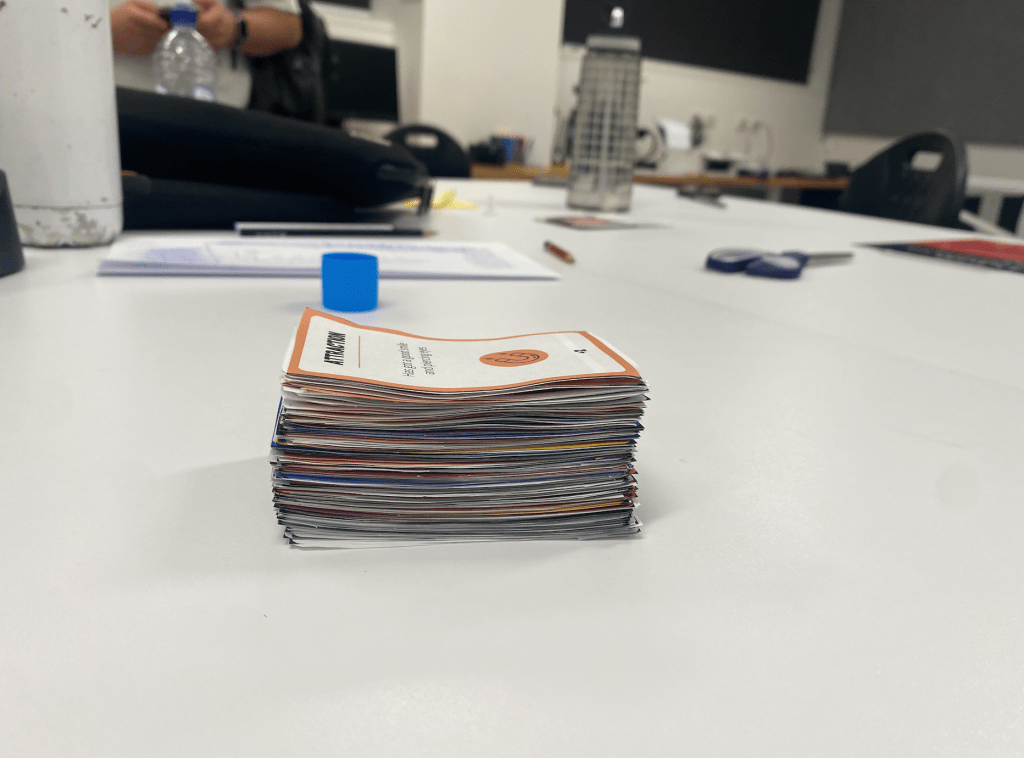
The most difficult part of this project for me was printing the cards. It took Seth and I over an hour to print them, with multiple issues along the way and once we had printed the cards, both the fronts and the backs, we had around 260 cards to cut and glue together. Seth, Hunter, Tobias, and I were the ones who did this physical aspect of the game design and it all came together quite smoothly.

Final play testing with made up cards

Overall, I felt as though our team worked tremendously well together and evenly distributed the labour not only the best we could but, whilst utilising each individuals skills they could bring to the table.  

Tabletop Game Analysis

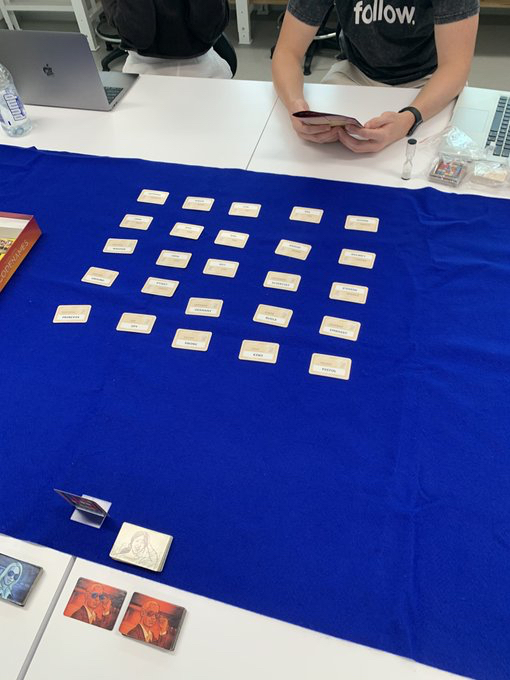
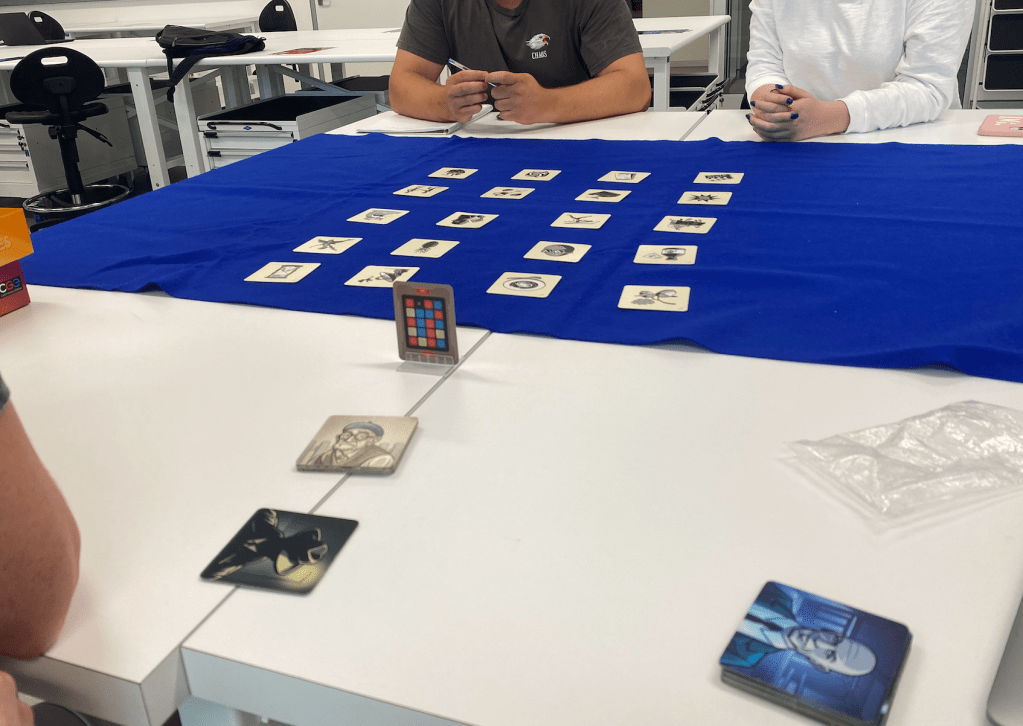
Codenames

Codenames was the first game we were introduced too in class and I think it was the best way to be introduced to tabletop games this semester. Being aimed at the age demographic of 14+ years made the game one of the easiest to understand just strictly through the ‘Game Overview’. I would say this is where I had my ‘ahhh’ moment of my understanding of the game. At first it reminded me of the game Battleships, however after we started to play the game, this opinion changed quickly. It took us around 25-30 minutes to set up and read the rules for us to fully understand how the game mechanics worked. Once we started playing, an element of ease and free flow came across all of us players. As the mechanics of the game are based around guessing and just taking chances, this created our magic circle to feel as though we were fully in the game, we eventually just lost track of time.

My affective responses to the design of the game were to be in the moment of the game and not think about anything else. Another thing I realised as a response to this game was wanting to know my players better, as I find it would be such an amusing game to play with good friends or family. My personality type is very ‘rip off the band aid’ as I like to say, and this game was the epitome of that. Even if I was unsure about whether my answer was right or wrong, it didn’t matter to me, I just wanted to say it and move forward. As the field operatives were guessing the cards, I noticed that if they were to get 2 or more correct in a row, the confidence level was getting higher and higher as you felt that you were ‘on a roll’.

To me this game didn’t have a setting or story per say, as it didn’t include fictional characters there was really no need for the game to be set in a particular era or place. The guessing and risk element of the game made the tension between not only the two teams but amongst our team players grow. There was a sense of not wanting to let your Spymaster down by not understanding their clue correctly. The playfulness of the game made it feel effortless and this also reflected the components of the game. In saying this, however, it is a very cognitive game as there is a lot of mind work that goes into it. Once we reached the flow state, which I would say was after about 2 turns of the first game, the game formed its own magic circle and we all wanted to stay in it.

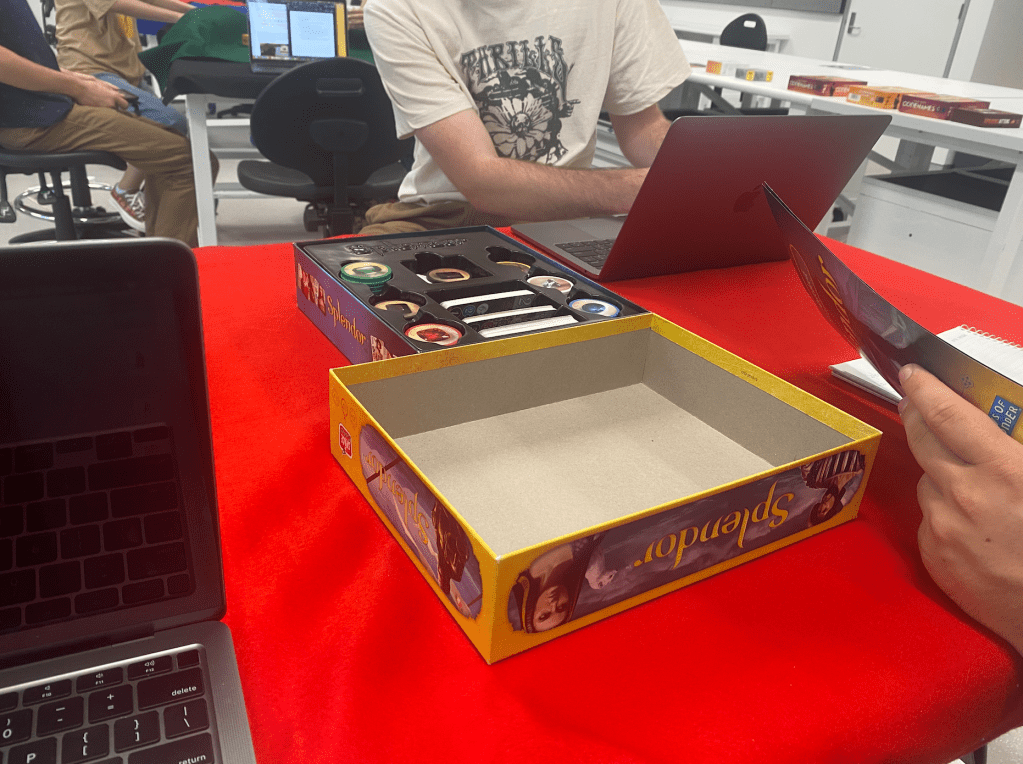
Splendour

Opening the box of this game couldn’t have been more of an opposite experience to Codenames. When we opened the box, we all felt so overwhelmed. There was so much to the mechanics of the game and the use of the word ‘token’ was throwing us off so much. The confusion for me kicked in as we were setting up the game, whereas with Codenames, I never felt confused. The learning process of this game was slow and took up a lot of time. It took me a while to figure out the aim of the game as I felt the games rules were written to people who already knew what the game was and not aimed at people who had never heard of the game before. So, we decided to just start playing the game and not worry too much about what the written side was saying.

Before starting, though, I did feel ‘poor’ as the game overview and instructions kept talking about tokens, and I didn’t have any as of yet, so I felt like I was already behind. This game, very early on, became very strategic. As it was every player for themselves, I felt that I had to always watch out for what my opponents were doing and the actions they were taking. This quickly became way too overwhelming as keeping up with my own game took up enough brain space for me as it was. This games magic circle was a completely different vibe to Codenames. Codenames felt as though it connected us all together and formed a somewhat friendship, whereas Splendour was very much ‘you are my opponent and I want to beat you’. I didn’t feel the need to know the other players. However, the magic circle was one of competitiveness and strategy.

We realised that this game was one that was going to take a lot longer to play, and in saying this, about an hour into the game we discovered we had been playing the game wrong with one of the rules. Despite this, we decided to continue playing the way we already were as we felt it sped up the process so much more and created more of a flow to the game play. We concluded on that thought by feeling that if we had followed the game rules properly then it would have made the game so much slower. The game started off really slow then picked up as we got further along into the game as not only everyone understood the game but that is just how the actual game is.

The setting and story of this game wasn’t a major component of the game, although I did find it necessary for the game. Not so much the story but the setting. As the noble cards were a part of the game, this to me created a setting but not a story. This setting gave the game some sort of fictional feel to is it was said to me through understanding the mechanics of the game “the noble will come to you when you have the right number of gems”, this made the game feel more real than just another card game.

I ended up coming last in Splendour … how disappointing of me. 

Until Next Time, R.

Life Beyond Our Screens

Being part of the 21st century and the growing of social media platforms we often tend to get caught up in the world of likes, shares and comments. It can take up so much of one’s time that we often forget there is a life beyond the screen.

Life beyond our screen is something that many have considered since the rise of social media. This is called, communication avoidance or media refusal. These are individuals who make the decision to ‘quit’ social media. Some choose to quit a specific application, whilst others choose to get rid of all forms of social media. After watching The Social Dilemma on Netflix, a couple of months ago, I can’t say this didn’t cross my mind. This show opened my eyes so wide that I seriously reconsidered my whole online presence. I ended up quitting social media for a week – which isn’t a long time, but for someone who uses it every day it was a minor ‘challenge’ for me to take on – and I ended up having a week of such ease and grounding. I was able to open my mind and be more creative with my spare time which I would usually just be on my phone or using social media. In this time, I journaled, read, went on walks, meditated, made extra time for the gym and so much more. I genuinely just had more ‘me time’.

A blog written by Rohit Kumar Neralla, posted on Noteworthy – The Journal Blog speaks of his experience of quitting social media ‘cold turkey’. He decided to delete and deactivate the four major giants, Facebook, Instagram, Snapchat and Twitter. The first thing he noticed when deleting these was the large amounts of ‘friends’ he was going to never hear or think of again. He had all these friends or followers on his social media that were so irrelevant in his life, and none of them would even notice he left social media. Neralla goes on to speak about the first 4-6 months and how hard they were for him. He suddenly had so much spare time on his hands and he decided to fill it with YouTube and Netflix … which I guess defeats the whole purpose of why he made this decision. He states that within this 4–6-month period, he deleted and redownloaded YouTube and Netflix so often as he kept wanting to quit them too, but then didn’t know how else to fill his time. Then he had, what he likes to call it his epiphany.

“I realised that all my mindless consumption had created a void in me. I did not- and could not – really use these tools to create something meaningful that I could be proud of.” – Neralla says.

This epiphany ignited something within, which is when he began to reap the benefits of quitting social media. He found his passion, mindfulness, and began writing, journaling and becoming a better version of himself. He started to well and truly know and learn more about himself than ever before.

Significance

This blog sparked something in me about my research, I want to find out the affects quitting social media has on an individual. I know that these affects will be different for everyone, taking into consideration their job or what their role is in society. Some individuals genuinely need social media for their livelihood, however, there are a large group of us that really don’t need it at all, we just think we do.

This is why I think this research question of ‘what are the effects of quitting social media?’ is so significant. This question is worth investigating as it not only effects an individual who is thinking of quitting social media, but it also effects the social media giants. If someone who is quite well known decides to deactivate his or her account – a vast majority of users may follow which then effects that media application. This could cause people who work in media to lose jobs, lose track of their insights or even slow down on trends. Therefore, I think this research question matters to any individual who has a social media account and the owners of the media platforms. If these owners can understand the benefits and negative impacts of deactivating social media, they can change their application to ensure users don’t make this decision.

Background Research

SCL Health wrote an article on the pros and cons of quitting social media. Some of the reasons why they think quitting social media will benefit an individual are happiness and mood booster, improved self-esteem and better sleep. These have all been proven by research however on the other end of the spectrum there are also reasons not to quit social media, according to SCL Health. These include, not missing out on potential events, the internet can be good for certain aspects of life and expanding your networks. Overall, although this article highlights both the pros and cons, without even reading further into it, I feel as though majority of individuals will lean towards the pros in this case.

A Conscious Rethink’s article ‘If you quit social media, you’ll notice these 6 big benefits’ studies shows more benefits that people should seriously consider if they are thinking about quitting social media. These include, no longer comparing yourself negatively to others, feeling less lonely and down, no longer potentially damaging hate speech, feeling less overwhelmed and more empowered, not judging others for what they post, and toxic people may leave your life. This study really digs into the depth of social media and how it affects users’ everyday life. We often forget how much we are comparing or judging others just simply based off a post and by quitting social media you are diminishing this happening in your life.

Overall, this semester I am really looking forward to digging deeper into the effects media refusal or quitting social media has on one’s life. Who knows, we may learn so much more about ourselves then we realise.

Until Next Time, R.

Reference List

Rohit, K, N, 2019, ‘1 Year Without Social Media, Noteworthy – The Journal Blog, viewed 21 May 2021, < https://blog.usejournal.com/1-year-without-social-media-74308965ccc2 >

Unknown, 2018, ‘The Pros and Cons of Quitting Social Media’, SCL Health, viewed 22 Mary 2021, < https://www.sclhealth.org/blog/2018/10/quitting-social-media/ >

Catherine, W, 2020, ‘If You Quit Social Media, You’ll Notice These 6 Big Benefits’, A Conscious Rethink, viewed 23 May 2021 < https://www.aconsciousrethink.com/13415/benefits-quitting-social-media/ >

What’s Hidden – Reflection

Choosing a potential story for this assignment was quite challenging for me. I just really struggled to get in touch with my creative side or know what I wanted to do a story on. However, once coming up with the idea, it was quite clear to me how I wanted my visuals to look.

With my story, it is quite a difficult one to capture the story in images. The reason for this being that Jon’s dream began when he was a young boy, living in Chile. As the images couldn’t portray how his dreams began, I thought that the audio side to my assignment should tell the story and the images show him as he is today, a man who made his dream a reality. The images start with a couple very simple images of Jon sitting and smiling. I started off with these simple images as I wanted the audience to capture an image of what Jon looks like as for the majority of the rest of images in the video, he is walking to the garage. I decided to make the majority of my video of Jon walking to the car to portray the long journey he travelled to get where he is today. A marriage, 3 children, owning his own hair dressing salon and then a divorce, to finally know when the right time to purchase his dream car was.

I wanted my story to be inspirational but no music I found helped create this, so I decided to leave the majority of the video with just his voice – besides the dirt road footsteps and car being turned on. For the majority of the audio, Jon is speaking of the leading up and the story behind his dream car and this truly brings out the ‘hidden’ aspect of the story. Photos are so important to tying a story together and making it more intriguing for readers. When reading a new article online, you will notice a few images throughout the story, even with little to no explanation behind the images, they help ensure the story is brought to life.

In Week Twelve’s, Multimedia and Photojournalism Ethics, reading ‘The Ambiguity of Pressing the Shutter’, it speaks on the tragedy that the most famous photojournalists had to go through. From wars to bombings, they were there and were forced to pull out a camera and capture the moment even if they felt it be inappropriate for the sad time. Whilst reading through this fascinating article it lit something in me, photos are so powerful for capturing true and raw emotions. The images and tragic moments that were taken by photojournalists Yoshito Matsushige, David Burnett and Ketevan Kardava who are all the individuals behind some famous powerful images knew the history that they were making by capturing that moment. The emotions in the people’s faces are something that only still images will be able to truly grasp how horrible those moments were for them. Although my story is overly light-hearted compared to these photojournalists’ images, the one of Jon at the very end is of him driving his Porsche for the very first time. The happiness that he felt in that moment was captured and you can truly see it in the photo which shows the power of emotion that images portray.

In Week Nine’s, Hearing with Light, Seeing with Sound, reading ‘Mimesis and Diagesis’, “For all the tired clichés about pictures being worth a thousand words, news images do not ‘speak’ for themselves; they require this contextualising  language – traditionally this context has been the privilege of the textual journalist.” I find this statement to be quite important when it comes to editing your own visual/audio piece of even simply viewing one. There are some images that speak for themselves. Nonetheless, when telling a story, it is the words that are most important in getting a message across, the images are just there for what the words cannot and should not say.

In the same reading it states; “It must be remembered that still images were the basis of early filmmaking.” This sentence really helped me make sense of this whole assignment. Animated movies, back when they first were being produced, was a large number of images all taken to produce motion-like actions and create a whole film. This shows how early on photos have been important in photojournalism and film, and although it shows a story it does not necessarily tell the story. Audio and visual are kind of like a package deal, especially when it comes to photojournalism or film.

References

Murabayashi, A, ‘The Ambiguity of Pressing the Shutter’, Ethics in Photojournalism, viewed 7 November 2020 https://zekemagazine.atavist.com/ethics#chapter-2859510

PDF from Moodle, viewed 9 November 2020

Making Dreams a Reality

Everyone has a dream. Whether it be to travel the world, becoming an actor or purchasing that one car, we all have a dream. It is what gets us out of bed some days, to know that we are working towards something great. But have you ever wondered what happens once you turn that dream into a reality?

Jon Tapia, father of 3 and owner of a hair salon, had a dream of one day purchasing a convertible. When he was around 9 years old, he saw a picture of a convertible in a magazine and thought to himself ‘I am going to have that one day.’

Adding onto the dream, him and his father went on a trip one day when he lived in Chile and he saw a man driving a red convertible and as Jon said.  

“I could see the freedom that he must’ve felt driving … so I always wanted one.”

Jon then started to work on making this dream his reality and so once his kids had grown up and his divorce papers came through, he knew that it was the right time to possibly start looking into buying his dream car. He one day saw a Porsche and it sparked his inspiration to look into what car is meant for him. He then, did some researching and found the car that he absolutely fell in love with.

Sonia Lanzi, Jon’s partner said “I remember when Jon first told me about this car, he found that he had always wanted. He had contacted the seller and so we packed the car and drove to them. It was in Cronulla in a suburb called Little Bay. Jon was so excited the entire trip up.”

A young family owned the car that Jon had always dreamed of, and now that they had two little kids and were buying their first home this family didn’t have the time to properly look after the car.

“Her father bought it for her, and she had named the car Peace Portia. But because they didn’t have the time or money to look after her, they made the very hard decision to sell.” Sonia Lanzi said.

Luckily for Jon, this meant he was now the new owner of Peace Portia. After much discussion, Jon decided that Peace Portia’s new name, would be Grace and now when he drives Grace, he feels like a free man, just like the one he saw when he was 9.

The Daily Journal

My digital artefact is a blog dedicated to all things journaling, The Daily Journal. I developed this project because I wanted to produce something that was relevant to my life and relate to a specific community. After a bit of research on the topic, I found tremendous benefits to journaling which include; relieving stress, prevention of depression, improving memory functions, boosts immune system and overall an increased mental and physical wellbeing. I also found that journaling is a whole community of its own and everyone in the community likes to partake in self-care acts as well as share their different types of journals. I found that people who enjoy journaling also enjoy reading and sharing blogs, which is why I decided to stick to just a blog.  In my Beta I discussed expanding to other platforms. However, since then, I have not done so. The reason being that I didn’t want to over complicate my digital artefact. My original goal was to create a space for individuals to learn all things journaling and understand the benefits of it. I also wanted it to be a space where I was able to share things about myself and my journaling as I find that the journaling community will relate to it. It is a space for users to learn more or learn about journaling, as simple as that.

Creating the blog site was harder than I originally thought it would be. I had to create an aesthetic for it and I really struggled to get it right. The final design I think is okay. I feel as though if I had edited and designed it a bit better it would look so much more improved; however I think the idea is there.

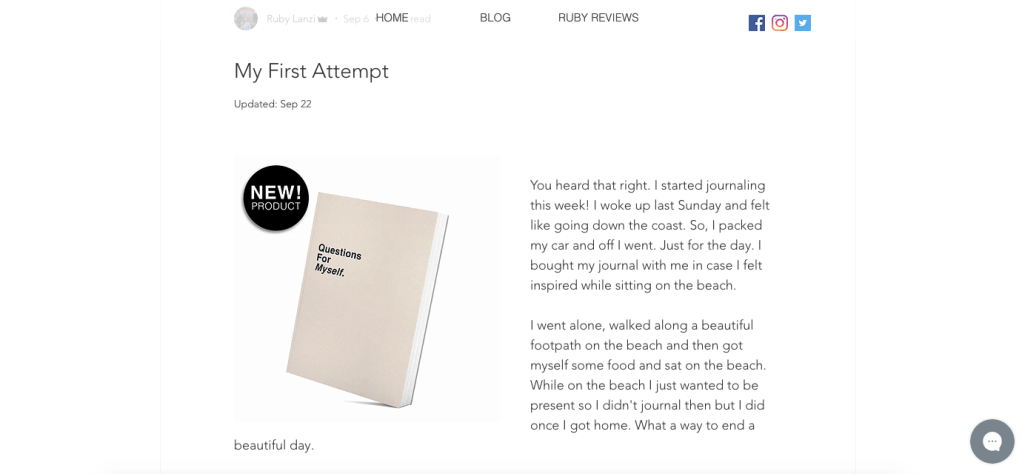
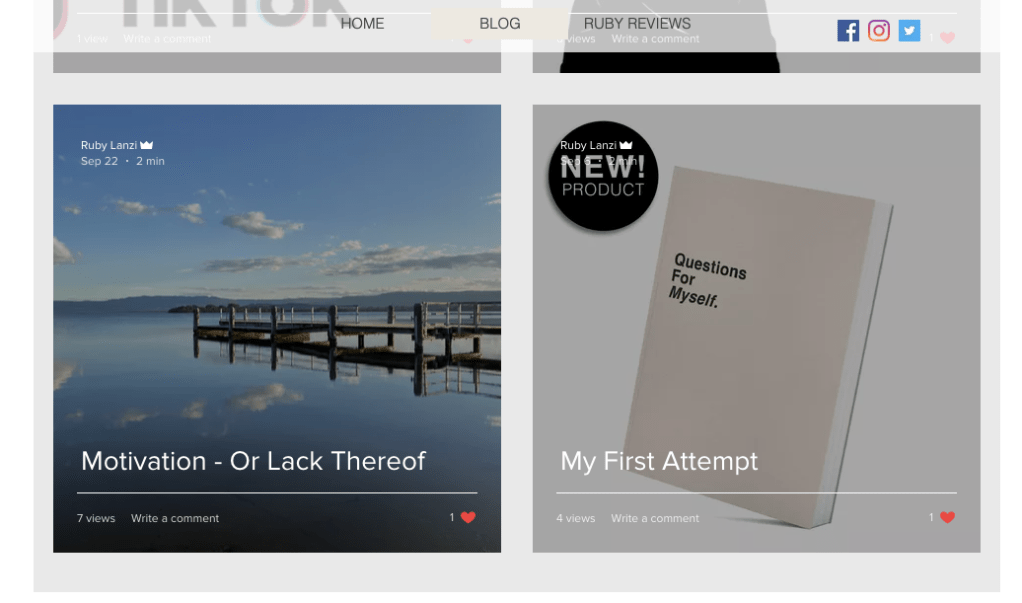
I made my first blog post about my first attempt at journaling. It was a major challenge to start getting into the swing of things and starting to write, and in my blog, I was very honest about it.

Each blog post has writing, and one image. I did this as I wanted it to look simple and be easy to follow.

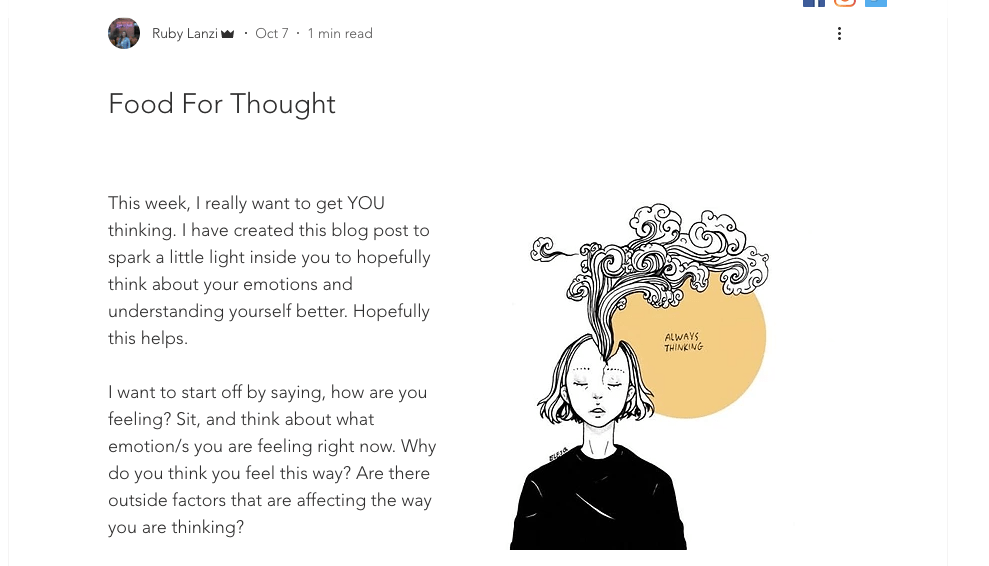
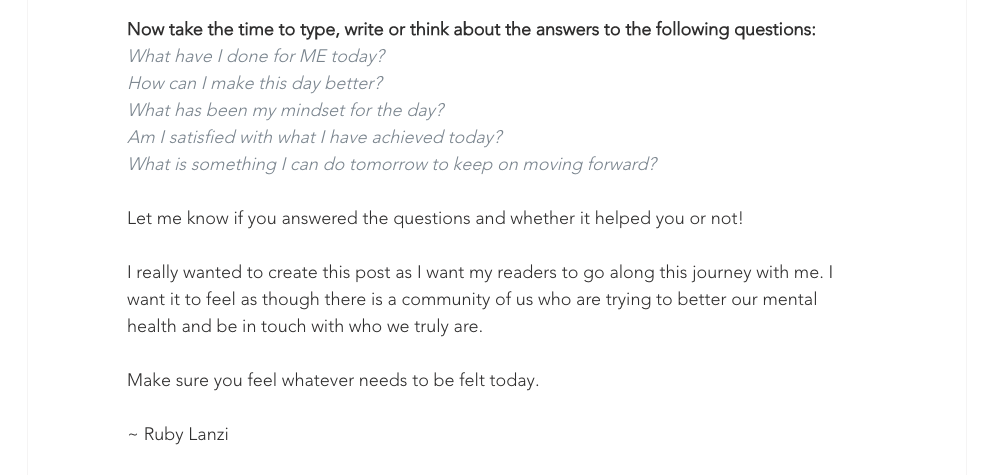
After writing two blog posts about my own personal journaling journey I realised how repetitive this blog would get. And so, for my next blog post I wrote one for my audience to follow. Food for thought, is a blog post basically for my audience to follow along and journal as they read. I ask questions and each question is directly followed by another that stems from the previous question. My aim for that specific blog post was to show others how easy it is to journal and if they hadn’t done it before, to see how they would feel. But for people who do journal, for them to have something to follow instead of freely writing.

My latest blog post was about me turning off my notifications. After watching the social dilemma on Netflix, I came to the realisation that I needed to fully involve myself in my emotions, bettering my life and journaling – which all things are what this digital artefact is about. I went social media free for 5 days, and I have never been more present and calmer in my life and so writing about my practice with it was the most therapeutic experience.

Overall, I am happy with where my DA is at, however I have had little to no engagement with my blog site which was a bit disappointing. Even though I have posted a couple of the blog posts on my twitter account with hashtags, I have found that still no one is gravitating towards the blog. I think the reason for this is that I am reaching out to the wrong crowd and should have posted it in a journaling group on Facebook or Reddit, where my true audience is.

R.