Narrowing my Field Site

Having my media niche fit into the realm of lifestyle, more specifically wellbeing opens me up to a lot of different ways to approach this subject. Narrowing this down however has been quite easy for me, lately I have been so intrigued by the notion and idea of journaling. When researching into journaling, it feels like a whole new world and perspective on life, both what I like to be seeing. So, through this, I made a mind map connecting journaling to different field sites.
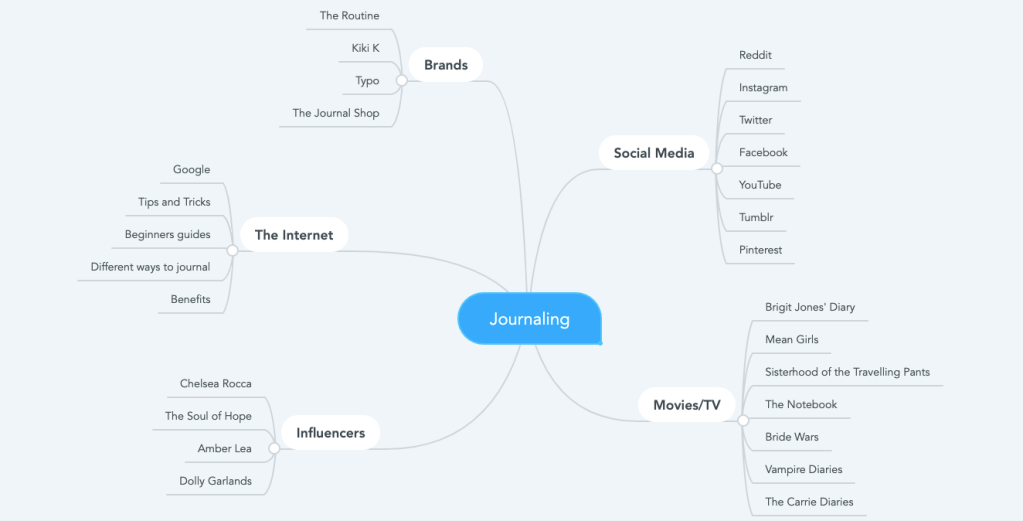
To understand this mind map, I will talk about what a field site is. Basically a field site is not one specific place or thing, it is a range of different places, people, things, sites etc that hold any type of information or connection to a certain niche. Because we are looking at this niche in an ethnographic frame of mind, we must also understand what ethnographic research is. Let’s break it down.

Ethnographic research: “The study of the culture and social organisation of a particular group or community … Ethnography refers to both the data gathering of anthropology and the development of analysis of specific peoples, settings or ways of life.” Studying ethnographically means to truly understand one particular group, community or concept and this then involves participating or observing that specific area. The whole idea of it, is to truly understand a problem and come up with a better solution to fix this. Therefore, with my media niche circulating around journaling, I intend to begin my own personal journaling journey and truly seek its benefits. Are there any? How come they are there? Why is being in touch with your emotions so important to understanding yourself? How does one simple act create such a large impact?

Field Site: This involves anything to do with a certain area of interest. Whether that be people involved, branding, places to find it, media sites, physical and non physical places, products … anything at all. Therefore, as seen above I have narrowed down some field sites connected to journaling. I placed them into headings and branched off more specific from there. These are all places/people/products that I have found since slightly touching on researching further into the spectrum of journaling.

People who might be interested in my niche are people who have similar interests to me, such as lifestyle and wellbeing content. Not only this but people who regularly journal, no matter the form they choose to do this.

I bring a new perspective to this area of study. The reason simply being I haven’t done it before and want to and will learn as I go. I am interested in this aspect of life as I want to better my wellbeing by doing simple things daily, and it appears that journaling has a world of its own. I want to learn about this world, this community and society of people who share a common interest and see what else they have in common. Is there a negative connotation based around keeping a journal?

There are multiple articles stating the benefits of journaling on mental and physical health. These include reducing stress, improving immune functions, memory improvements, mood booster and strengthening emotional functions. This is fascinating to me, how does it help someone so much though? Well, by prioritising your problems, fears and emotions you are allowing yourself to face them properly, understand them and let them go. It also allows room for more positive self talk and that is something that is highly underrated. As our minds are constantly thinking whether we are aware of it or not, it is important that for the most part these thoughts are in a positive mood and attitude.

“Smyth’s team studied 107 people with asthma and rheumatoid arthritis. He asked half the group to write for 20 minutes a day for three days about the most stressful event they could remember. The control group was asked to write about their daily plans. Four months later, 70 people in the group that wrote about their stress showed improvement. Only 37 of the control group improved.”

All in all, furthering research in journaling with an ethnographic approach appears, to me, to be the best way to truly understand this niche and try solve the stigma around ‘keeping a journal is for 12 year old girls’.

Stay True, R.

[Edit 03 September 2020 below]

References

Calhoun, C. J. (2002). Dictionary of the social sciences. New York: Oxford University Press viewed 14 August 2020

Unknown, 2020, ‘Fieldsite’, viewed 14 August 2020 < https://www.yourdictionary.com/fieldsite#:~:text=(plural%20fieldsites),where%20fieldwork%20is%20carried%20out. >

Leo, 2018, ‘The 17 Different Types of Journals that will Keep your Life Organised’, viewed 14 August 2020, < https://www.jofelo.com/17-different-types-of-journals-to-keep/ >

Bailey, K, 2018, 5 Powerful Health Benefits of Journaling, viewed 14 August 2020, < https://intermountainhealthcare.org/blogs/topics/live-well/2018/07/5-powerful-health-benefits-of-journaling/ >

Watson, R, 2020, ‘Journaling for Mental Health’, viewed 14 August 2020, < https://www.urmc.rochester.edu/encyclopedia/content.aspx?ContentID=4552&ContentTypeID=1#:~:text=Journaling%20helps%20control%20your%20symptoms,and%20identifying%20negative%20thoughts%20and >

Hartwell-Walker, M, 2018, ‘Writing for Health, viewed 14 August 2020, < https://psychcentral.com/lib/writing-for-health/ >


Where the Internet Began

Animated GIF - Find & Share on GIPHY
made with Giphy


Learning about how the telegraph opened up the world is kind of inspiring.

Basically, in the 1800s Samuel Morse invented the telegraph, because, after
receiving bad news about his wife, he was unable to communicate fast enough to
be there for her. And so, he dedicated the rest of his life to fast
communication. And boy did he open up a new world.

The telegraph appeared to be complicated for personal use, so multiple
inventions were then created. One of these being, the radio. When the radio was
invented, so was the living room. How does this happen from one invention? The
telegraph literally was a growing point in the lives of individuals all over
the globe. Literally creating the living room in each household for families to
listen to entertainment and news all came about because Samuel Morse had a
goal. Real life communication. Before we knew it, the world became a nervous
system.

When I say this, I mean everything was connected by these ‘mystical’ wires
that enabled the world to connect with each other like never before. It was
mystical because people couldn’t physically see the connections but they knew
it was there, yet so foreign to them. Literally looking and acting like a human
body’s nervous system.

And that, is how the internet began.

Until Next Time, R.

My Media Niche

My media niche is health and lifestyle vloggers, influencers or Youtuber’s.

When I say health and lifestyle, I specifically mean individuals who are ‘well-known’ for vlogging their day to day life, their health and fitness journey and even their mental wellbeing. Examples of the individuals I follow and watch are Sarah’s Day, Chelsea Rocca, Charlotte Freeman and Tayla Damir. These individuals all have something in common, they live each day trying to improve their mental and physical state and that is something that highly intrigues me.

https://www.youtube.com/channel/UCAHufvd02viJSRdt3ojdPOg
https://www.youtube.com/channel/UCWSksWN12Y997XdmcqVrQTg

However, when it comes to my ‘personal media niche’ mental wellbeing is what interests me most. Having a focused and positive mindset is something that every individual struggles with throughout their life and so with my media niche, I want to focus on mental wellbeing and how to maintain it as such. I would like to do this by experimenting with journaling.

https://linktr.ee/chelsrocca

In the past, I have never been one to journal religiously. I always thought it was for people with big secrets who wanted to talk about their day or someone who has a big crush. Nonetheless, research has proven that journaling increases ones mental health. I want to learn about journaling and help others learn about it too. Find out the truths, deception and most importantly the outcomes of being someone who regularly journals.

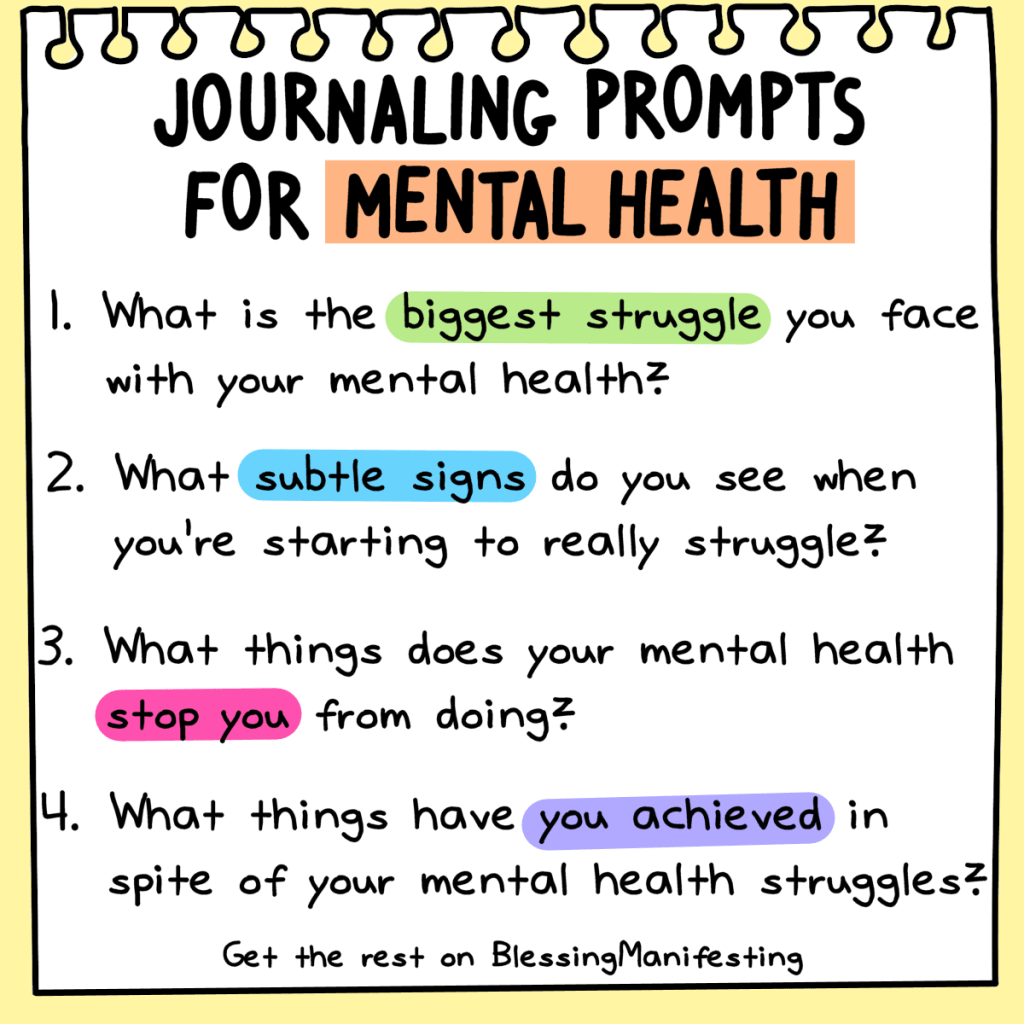
“Journaling is simply writing down your thoughts and feelings to understand them more clearly.” When researching into the benefits of journaling, the outcomes seem to be tremendous. Controlling and understanding your feelings, finding your sense of self and lessening mental disorder symptoms such as anxiety and depression. “It can make us more aware and help us detect sneaky, unhealthy patterns in our thoughts and behaviours.” This then makes us more aware of our life and enhancing our ability to control our quality of life.

https://www.blessingmanifesting.com/2018/07/12-journaling-prompts-for-mental-health.html

Journaling appears to be its own culture and experience away from any other. There are all different types of journaling such as bullet journaling, food, travel, dream, writing and many more. All of which seem to have a positive outcome. Hayley Phelan states in a New York Times article that journaling is one of the best ways for self-care and also one of the cheapest. Setting aside 5 – 15 minutes a day to journal, ask yourself hard hitting questions, google journal prompts or writing about how you felt that day has proven to enhance thousands of individuals mental wellbeing. It is genuinely helping people.

Writing your feelings, asking yourself specific questions and writing down the answer can enhance your mental wellbeing? Count me in.

I intend to explore this in detail through extensive primary and secondary research. Instead of just finding articles and blogs about the benefits of journaling – which I will do – I will also begin to regularly journal and see where my journaling journey takes me. I have stumbled across a business named The Routine, who promotes healthy mental wellbeing. I intend to follow their ‘Questions for Myself’ journal and see if it benefits me in any way. Journaling may not be for everyone, but I feel it is relevant as it is something so simple and small that seems to have a large positive impact on self-care.

Therefore, my personal media niche is lifestyle and promoting a healthy living style.

Stay True, R.

[Edit 03 September 2020 below]

References

Watson, R, 2020, ‘Journaling for Mental Health’, viewed 5th August 2020, < https://www.urmc.rochester.edu/encyclopedia/content.aspx?ContentID=4552&ContentTypeID=1 >

Ackerman, C, 2020, ’83 Benefits of Journaling for Depression, Anxiety and Stress’ viewed 5th August 2020, < https://positivepsychology.com/benefits-of-journaling/ >

Leo, 2018, ‘The 17 Different Types of Journals That Will Keep Your Life Organised’, viewed 5th August 2020, < https://www.jofelo.com/17-different-types-of-journals-to-keep/ >

Phelan, H, 2018, ‘What’s All This About Journaling?’, viewed 5th August 2020, < https://www.nytimes.com/2018/10/25/style/journaling-benefits.html >

214 Contextual Statement

“Social innovation refers to new ideas that work in meeting social goals.” Pol, E and Ville 2009 Social Innovation. This was the quote that formed the foundation of our app Hide and Seek. My group wanted to create something that was not only relevant for our age group but that was also benefiting a niche market. This is why Hide and Seek has so many features.

These features portray convergence culture. Henry Jenkins describes convergence as “the flow of content across multiple media platforms, the cooperation between multiple media industries and the migratory behaviour of media audiences who would go almost anywhere in search of the kinds of entertainment experiences they wanted.” Convergence culture is the combination of multiple media platforms into one, which creates an easier platform for one to use. It is the emerging of different forms of media to enhance technology and social media. Hide and Seek aims to better enhance the health, safety and social goals of festival goers.

We came up with this idea by discussing what part of festivals really make the experience difficult and then formed a solution to these problems. The first one, and most major one for all festival goers, is the lack of reception at the event which, after much research we decided to use Facebook Aquila Drone service. This enables our app to differ from other media platforms which may also cause digital disruption. The reason for this is as our app has no connection issues, we are placed at a higher level to other media platforms that heavily rely on internet connection, 4G and 5G.

Other issues we came across was losing friends at the event, injuring yourself and trying to find a safe ride home after the festival has ended. This is where the mapping aspect to our app comes into play. The map on this app is a live app that not only allows users to find their way around the festival but also track their friends, so they know their whereabouts. On top of this, the QR coding system enables users to send codes to emergency services to help an injured individual or someone in danger at the festival. Also, the message, call and video aspects of the app ensure that communication at the festival is seamless without the hassle of wondering if the connection will fail halfway through a call or text. Not only this but to actually attend the festival, a ticket must be purchased and so to really tie the app together we decided on having a ticket storage function. We truly believe that this function really brings the whole app together and achieves our goal of creating a space where all festival needs are in the one area and so there is no need to go from one app to another.

Overall, I truly believe that my group has created something that we are all really proud of. The app has enabled us to solve a social problem and has achieved goals of meeting health, safety and social needs. We really tried to guarantee that the app was realistic yet never heard of before.

REFERENCES

Jenkins, H. 2006, ‘Welcome to Convergence Culture’, Henry Jenkins Blog,

http://henryjenkins.org/blog/2006/06/welcome_to_convergence_culture.html [accessed 16 June 2020]

Jenkins, H. 2006, ‘Convergence Culture’, MediaWiki

https://mediawiki.middlebury.edu/MIDDMedia/Convergence_Culture [accessed 16 June 2020]

Losinno, R. Pickering, S. Schembri, C. Smith, H. 2020, ‘Hide and Seek’, Google Forms,

https://docs.google.com/presentation/d/1UxIKHrtz3qpS7gQuxOCnTbzj6TZMzbWh_RbHVAtQFj4/edit#slide=id.g730da0deea_2_6

[accessed 16 June 2020]

Rouse, M. 2019, ‘Digital Disruption’, Tech Target Network,

https://searchcio.techtarget.com/definition/digital-disruption [accessed 16 June 2020]

Reflecting: 212, Assignment 3

What. A. Semester. This semester has been the definition of a rollercoaster and so has this assignment.

The first struggle I came across was refining my topic. I knew I wanted to further research into Uni students and the friendships they have made but I was so interested in every aspect of it that I just didn’t know how to refine it. Then that is where I thought to write about how the different types of relationships formed at Uni are conducive to a positive student experience. I wanted to know the good that came out of meeting people at Uni.

I conducted and tweeted my survey around 3 times and replied to countless people who all said they did my survey. I got 30 respondents and I am more than positive I did well above more than 30 surveys but that is okay, we let that go.

I knew I needed more information from my primary research, so I made a second survey and sent it to people based off of what they answered in my first survey. I wanted people who were going to give me detail and were open enough to tell me more about their student experience. After the 8 individuals completed this, I had all the information I needed. Then I came across my next struggle, what the hell do I write about now?

GIPHY

I didn’t have enough information off of the different relationships that could form through Uni to write a piece about it, so this is when I came up with the idea to write about the benefits of making friends at Uni. And I finally had a question to answer, pat on the back for me.

If I could change anything about my process it would be to not do a survey. I think interviewing people would have helped me so much more, just getting straight to the detail instead of trying to get 100+ students to answer a survey where I don’t even know 98% of them.

I am, however, happy with the results and the final (finally*) question that I answered and the researching findings that came along with it. I actually really enjoyed reading up about friendships and seeing how everyone else in my degree are meeting people and what they think of the friendships they have formed. It has given me a sigh of relief as I have most definitely lacked in that area, but hey, I’m growing and learning.

Stay True, R.

Is There A Benefit to Making Friends at Uni?

Upon beginning the crazy adventure that is University, you will most likely be told that you are going to meet your lifelong friends and make forever type of connections. Although this is true for some, it is not the case for all, and that is totally okay. However, after conducting primary and secondary research, I have wondered and found an answer to whether or not there is a benefit to making friends at Uni, even if it is short term.

Although I feel like I have found this answer, keep in mind that my sample size is quite small and relates to strictly Communication and Media students, in BCM212. I sent out a survey on my Twitter for these students to take and I managed to receive 30 responses. I also sent out to 8 of the responders a second survey which asked more in-depth questions, and this is where I found an answer and refined my research.

Figure 1

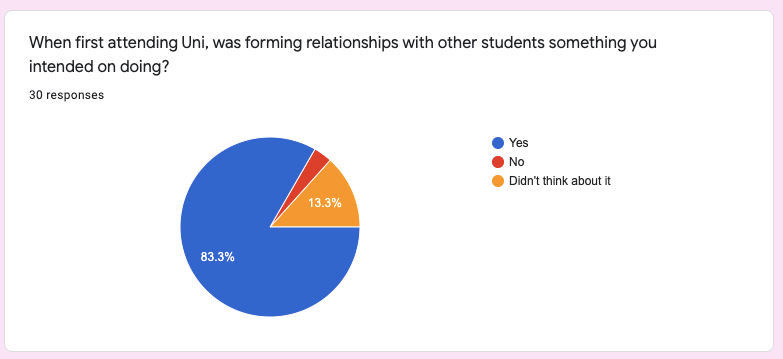
As seen above, 83.3% of 30 respondents said they had the intention of making friends when starting Uni and this shows the expectation of friendships to be made whilst studying. Going in with the mindset of forming relationships really helps shape the way you will experience Uni and determines the relationships you are forming. This leads me to another question in my first survey.

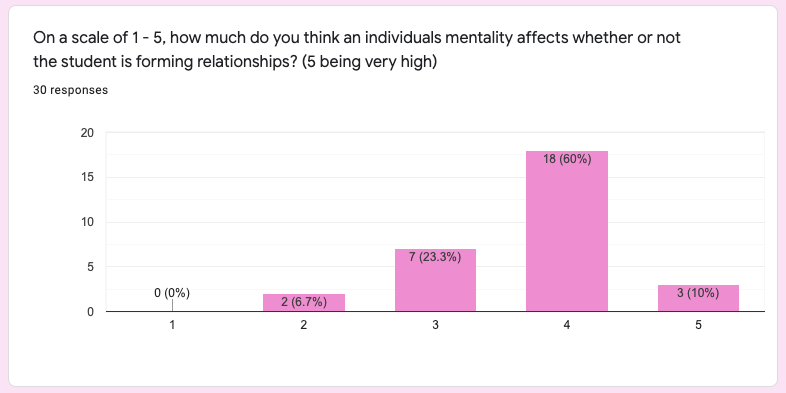
Figure 2

Out of the responders, 60% thought that an individual’s mentality highly affected whether or not a student will form relationships. This proves, in order to make these connections, there needs to me a mindset of wanting to form relationships.

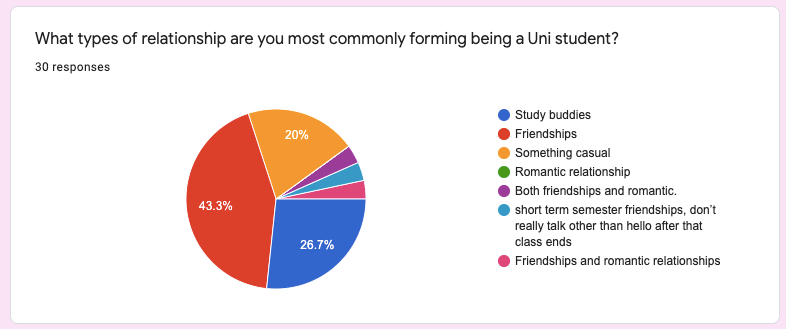
Figure 3

Most individuals stated that these aren’t lifelong friendships as they either won’t speak after the semester ends or they can tell that it will eventually fizzle out once completing Uni. Seeing this, truly crushed having an expectation of creating these lifelong friendships at University, nevertheless, this doesn’t mean that these friendships don’t have its benefits.

Deakin University wrote an article about whether or not starting Uni means the end of High School friendships. 50% of responders of my survey started Uni with friends and majority of them found it to be more beneficial when it came to making friends at Uni as it gave them a confidence booster and enabled them to not feel alone during their first year. Deakin University writes that some of these friendships will drift no matter the cause and one of the benefits of making friends at Uni is that these friends will have more similar interests to you. Not only this but they will more than likely have the same goals and enable you to grow as a person through a diverse group of friends. This article also shows how the people you meet at Uni would probably have grown up differently to you, and that this will assist you to learn more about yourself. One point that stood out in this article was that making friends at Uni will also help you to define the friendships you already have and that you are willing to continue life with compared to those who aren’t meant to complete life with you, this is such a strong benefit to making friendships at University.

ABC Life wrote an article about friendships being the best part of Uni. This article states “studies consistently laud the wellbeing benefits of healthy friendships” meaning that making healthy friendships helps to increase the overall wellbeing on an individual. It states that healthy relationships reduce the risk of mental and physical illnesses as having people to talk too and live life with causes a much healthier overall lifestyle. Similarly, University of Saskatchewan wrote an article titled ‘Good Friends Help Us Live Longer and Happier Lives’. Studies have shown that in order to improve one’s mental health, a way to do this is through a great social support system and connecting with friends through school to lessen stress and enjoy having a companion which ends up improving your grades. It sorts of ends up being a ripple effect.

Comparing the secondary research to my primary, I have found that most responders find that forming relationships at Uni is positively affecting their Uni experience. A responder said, “they give me help with assignments which helps with my stress.” Another said, “I feel like I have a wide network of people I can ask questions too and understand the work a lot more.” This is showing the benefits of having Uni friends, even if they aren’t lifelong. This being that the benefits may be short term however these benefits are still major in one’s life. With Uni, comes stress and making friends at Uni, even if they are not lifelong friends, they have a high chance of reducing this stress and enabling you to live a fun, young Uni life.

Two articles I studied by Year 13, both related to not being able to make friends at Uni. Both these articles spoke about how these individuals struggled to make friendships through Uni and felt that there was something wrong with them. This was due to the expectation of making lifelong friendships at Uni, but they were only making friendships that would end after the semester. Although their expectations hadn’t been met, they still found benefits from this. This being, they had people to help them through tutorials which allowed them to have a familiar face and it taught them they although they didn’t make friends at Uni there was still plenty of opportunities through life to make lifelong friends. The lesson learnt here was to not expect anything, go in with an open mind and if lifelong friendships aren’t formed then allow it to teach you a life lesson.

Similarly, a responder said that making Uni friends, “actually made me excited to go to Uni. Some days I’ll go just to hang out even if I don’t have a class.” Another stated “… helped me feel more comfortable in class and motivates me to show up to lecture and class when I know they will be there.” Being open to meeting people at Uni not only makes Uni life more fun and enjoyable but it makes it so much easier and allows you to stay motivated and connect with people going through what you are. When making friendships at Uni, whether that be study buddies, friendships, life partners or something a little more casual, overall these friendships will help you in the present moment. They will reduce stress, allow you to have a support system with people who are going through the same and allow your student life to be a fun one.

References:

Ferdous, A, Sharman, M, 2018, Does Starting Uni Mean the End of High School Friendships, Deakin University, 26 April 2020, <

https://this.deakin.edu.au/study/does-starting-uni-mean-the-end-of-high-school-friendships >

Hamde, M, 2020, Friendships can be the Best Part of Uni. Here’s Where they Start, ABC Life, <

https://www.abc.net.au/life/making-friends-at-univeristy/11923050 >

Joseph, 2018, Why I Gave Up Finding Friends at Uni, Year 13, 27 April 2020 <

https://year13.com.au/articles/gave-finding-friends-uni >

Student Wellness Centre, 2017, Good Friends Help us Live Longer and Happier Lives, University of Saskatchewan, 26 April 2020 < https://students.usask.ca/articles/friendships.php >

Unknown, 2018, Am I the Only One Without Uni Friends, Year 13, 27 April 2020, <

https://year13.com.au/articles/without-uni-friends >

  • Ruby.

Research Proposal: Uni Students and Lasting Relationships

For this semester, I will be researching into Uni students and lifelong relationships, whether that be a friendship or something a little more. What I want to find out is, whether or not students are connecting with their peers on a personal level and are forming lasting friendships. I want to research into how other students met their current Uni friends. Was it in a lecture, sitting in a tutorial or simply fate bringing them together by randomly crossing paths?

A young woman named Rachel is currently blogging her life experiences and she wrote a post about how she didn’t make any close friends attending Uni. Reading her weigh up all the possible solutions as to why this occurred, it begins to make me wonder, why are some people failing to make friends while others seem to find it easy?

Furthering on this point, Year 13, a very well-known organisation amongst most Australian students published a post by Genevieve Miller, who was an Australian Uni student. In this post, similar to the one above, she spoke about by the end of her first year she hadn’t met anyone that she would consider a ‘close friend’. “People will tell you that Uni will be this amazing experience where you’ll meet tones of people who will be there for you till, you’re old and grey.” This point is quite intriguing to me. Should we leave the stigma of University helping students make lifelong friendships behind? Why? This article also helped me to realise that my research topic is timely as the primary research conducted will be on second year and above students.

My idea for this research is, to begin with whether or not students knew people before starting their uni course. This, to me, has such a major effect on a student’s experience and can create such an issue among peers. I created a poll on this question.

The results of the poll interest me and I am very excited to further dive into whether or not knowing people or having friends start Uni with you positively or negatively affects Uni students making lasting connections.

Coming up with this research topic, a thought did come into mind, so much of our content that we need is online, is this affecting whether or not students are personally connecting with each other? In 2020, The Conversation uploaded an article about online lectures and a point was made that University not only teaches students content but it also teaches students how to communicate with each other and work in groups. This article has shown that my research topic is relevant as being online is a huge part of being a student in the 21st Century. The rate of online schooling continues to increase daily, especially through this pandemic that students and the world population are working through right now, proving again that this topic is relevant.

Another article on The Conversation about University campus experience, discusses the life of Australian students and a point made was “Students also indicated they were less engaged with their peers than students in the past have been”. This not only shows the relevance of my research but also affects my research topic greatly. If students are not engaging with their peers, then this is a major issue as to why some students are not creating lifelong friendships and connections.

I believe that my research topic is achievable as I have access to asking relevant students the right questions. These students are all second year and above, who are studying the same subject as me, so therefore this makes my research not only achievable but also relevant. These students have gotten a good feel of what their Uni experience will be like and know what they need to change or keep the same when meeting people.

I believe this topic is worth researching, not only as this is something that interests me, but it will also be important for current and future students to learn about Uni and lifelong relationships. We are constantly being told, “follow each other on twitter”, or “create a poll for your fellow peers”, but this isn’t helping students connect on a deeper level, or maybe it is. That is what I want to find out.

Deakin University, in 2018, wrote about meeting people and making friends and the article states that students must be open minded to meeting people in order to form these friendships, which brings me to another question, were students looking forward to meeting new people or was studying the only thing on their mind?

To sum up this research proposal, I simply want to learn as much as I possibly can about students and lifelong relationships. The overall idea is to find out how they are meeting, what type of connections are they making and what are factors that are influencing the relationships they are making?

Be Kind, R.

My Curiosity: Are People Connecting?

Every uni student has a different experience, even if they are completing the same degree. One aspect of uni life that I am extremely interested in is whether students are making life long friendships and connections.

During the completion of this media degree, we are asked to tweet, upload, create an online presence but are the students of this media degree making friends and life long connections? This idea is very close to my heart as connecting with people, making friends and potential partners is something that has always interested me. I love to know how people interact with each other, how 2 people met or even how a friendship group was formed.

An article written on The Conversation based around the changing experiences of campuses looks into Australian campuses. In this study, the writer discusses how Australian students spend more time studying at home rather than on campus and how students are spending less time with their peers than other students were years ago. I want to further on this research and find out why this is occurring and whether it is affecting students making life long relationships.

To complete this study, I will further research articles about Australian students life, on and off campus. Also, by conducting a survey to find out whether or not UOW Communication and Media students feel as though this degree is hurting or helping them meet people. This way, my study and research will be relevant to UOW and current Australian students.

Be Kind to Yourself, R.

My Curiosity – Connecting

How many meaningful connections do you think you have made in your life? This is something that interests me.

Maybe who you sit next to in class or the library, or walking a certain way to a lecture determines whether or not genuine connections are being made.

This semester, we need to find a focus on what we are curious about and last week I tweeted about what I want to focus on this semester.

I should’ve worded it differently, but we will move on from that. What I want to know is, whether people are making connections in real life, despite being in a media degree. I want to know if people are making friends, and not just a ‘oh yeah I know them’ friend, I want to know if people are making life long friendships and connections.

I am not someone who is half half, once someone knows me, they know all of me which is why I make, what I like to consider, soulful connections with the friends I have. Furthering on this point, I want to know if other students have struggled with connecting with people, and why they think their answer is what it is.

I want to know if people are being brought together through their media study, rather than staying behind a screen. Are we surrounded by these other specific students for a reason? What are things that are bringing people together and is there genuine connections being made?

I guess you never know the connections that are pending.

Only From The Heart, R

Making – Project Five

Despite the fact that this post is meant to be about the ‘making’ of ‘Project Five’, this area of the DA is where my group failed to actually create content. So, instead, I have decided to talk about the lessons I have learnt when it comes to making a DA and group work.

Before I get into the lessons learnt, ‘Project Five’ did establish a certain type of aesthetic in videos. These were as follows:

you get the idea …

When it came to making content in a group, the main struggle is to make sure everyone is in love with the idea and has enough enthusiasm to create content. The reason for this being that this degree is very self directed and so no teacher is going to be on your back about it. If nothing is made, that’s on you.

Having this DA being about a specifc type of content, made it difficult to ensure all five of us were on board with that weekly idea. On top of this, meeting up with the five of us there was another struggle and learning curve I came across.

Having communications and media being part of my double degree, I have a passion for this subject and also this DA. As other group members do not feel the same way, it was hard to constantly have this on the back of my mind as I wanted to be creating content but felt as though I couldn’t.

In summary, this semester has taught me a lot about myself, and about how different everyone’s outlook and characteristics are. Next semester, I think I will be coming up with a DA of my own so therefore I don’t feel the need to rely on other people for content.

– R.