I Have A Question For You:
You wake up in the morning, see a friend request on FaceBook from a familiar name and face but don’t quite remember who they are. Do you accept, decline, or leave it?
Introduction
Deception is “the act of hiding the truth, especially to gain an advantage”. A form of deception is when individuals create fake online profiles to lure in victims to begin a relationship or potentially make money off them.
Social media can be dangerous at times, so if there is one thing for you to take away from this explainer it’s to always be cautious when using social media. Social media is so powerful, use this wisely and keep it a safe space for all.
What is ‘Catfishing’?
Catfishing can be described as a “deception about one’s online identity, generally with an ulterior motive” Therefore, catfishing is where an individual creates a fake online identity and pretends to be someone that they are not in order to persuade another individual into a relationship or friendship.
Why do people catfish?
Some individuals use the ‘virtual world’ in order to live a life that they have always hoped for. Therefore, they live through this made up person in order to potentially help with their insecurities.
2. Revenge:
People who have had bad break ups, ex best friends, enemies and so on, are looking for revenge. Therefore they make fake profiles and try to ‘trick’ this individual or make a fake profile of the actual individual to get revenge.
3. Scamming:
Thus meaning, they make fake profiles in order to make money off others.
4. Mental health:
People with mental illnesses such as anxiety, depression and many more create fake profiles as they are scared to reveal their authentic self. Due to their mental illness, once this individual begins to live this life, it can become quite addictive to them without them realising the damage they are doing to others.
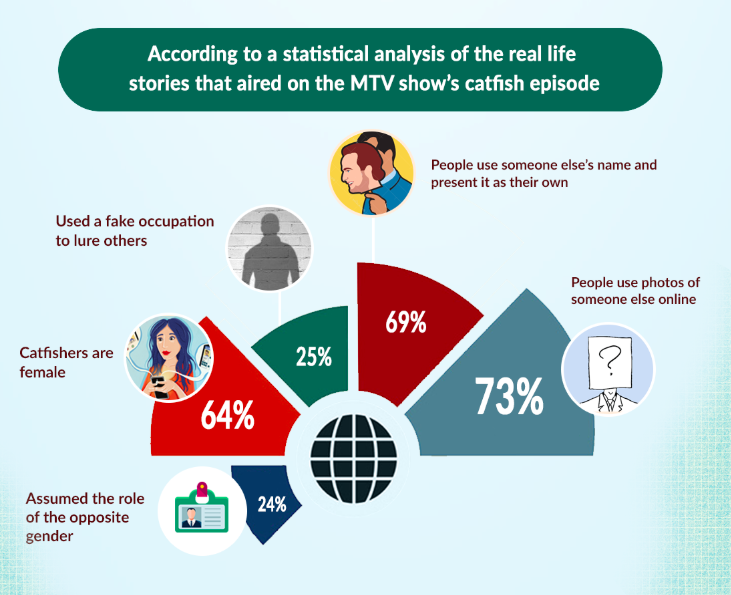
How do you catch a catfish?
There are many signs that an individual is being catfished but there are some main signs to always watch out for when using any form of social media relationship. If the relationship is progressing quickly without having met the other person then this is definitely a first sign to be wary of. If the person refuses to send photos of their face or FaceTime you, then something is fishy (pun intended). At this point of your ‘relationship’ an individual should be requesting to meet instead of keeping it strictly online. A huge sign that a person should see and understand is, if the catfish begins to ask for money. In this case, it is pretty clear that whoever the other person is, is only doing this for money. Those aren’t all the signs on how to catch a catfish but they are the main one’s everyone should be looking out for.
Some Cards posted about a lady opening up to her catfishing story. A 22 year old lady begun to talk to, what she thought was, a 27 year old army man. She ended up falling in love with him and told him about a story one time when she got drunk. To this story he did not react well and would throw in her face that she even got drunk to begin with. After an argument, he deleted her and blocked her and she was absolutely devastated. She tried looking him up on other social media accounts and couldn’t find him anywhere. Finally, she looked up his ID and found that he was a 40 year old man who catfishes not only women but men as well by pretending to be a female.
Looking up the individual’s name on other social media platforms will really give a good insight into whether or not you are being catfished.
Can authorities handle catfishes?
In serious cases of catfishing, police, private investigators, FBI agents, lawyers and courts can and will begin to involve themselves. The following is an example of a case where this occurred. The case has been ongoing for eight years now and will recommence for sentencing on June 6 2019.
Lydia Abdelmalek pretended to be well-known actor Lincoln Lewis, a star in Home and Away. A girl named Emma, who had known Lincoln Lewis from primary school received a FaceBook friend request from who she thought was Lewis. This fake account began to chat online too Emma and they ended up in an online relationship. They had spoken over the phone and planned to meet up a few times but ‘Lewis’ would always cancel last minute. After this went on for a while, Emma became suspisious, ended up finding the real phone number of Lincoln Lewis and the real Lewis confirmed that he had not in fact, been in touch with her nor been in an online relationship with her. He recently tweeted out the following tweets regarding his case.
After catfishing Emma on a second occassion, pretending to be her ex-boyfriend, Emma sadly committed suicide over the whole situation as she has genuine feelings towards ‘Lewis’. One of her friends stated in a police statement “She said she had lost the ability to function, she described to me that her mind and body were out of sync.” The fake profile begun to send threats to her victims which is where the Queensland police were involved. Abdelmalek is a 29 year old woman who lives in Melbourne and is now known for her catfishing abilities. She appeared in court in May 2019 after 4 years of trying to keep her name hidden and continuing on with catfishing victims. She has been found guilty of six different counts of stalking.
Through this story, there is something that can be learnt. Catfishing is a serious matter that police will not take seriously until threats and physical action is taking place. This is the reason why it is so important to always be cautious with who we are associating ourselves with online.
But, what can be done in the case of a serious catfishing scandal? If threats are being written, sent or published to you somehow, showing the police or FBI this evidence will be the best thing for you. They will then take matters into serious hands and help you catch your catfish.
Here’s My Answer:
To answer the question that begun this explainer … you do whatever feels right, but always ensure you are safe and meet the online user.
CITES USED:
Cambridge Dictionary 2019, ‘Deception’, viewed 14.05.19 https://dictionary.cambridge.org/dictionary/english/deception
Christine, MG 2019, ‘Family Not Spared From Catfish Spotlight’, news.com, viewed 22.05.19 https://www.news.com.au/technology/online/family-not-spared-from-catfish-spotlight/news-story/54a81cdf09698b6f884e6eeeabf3e0d5
DigitalnDigital 2018, ‘What is catfishing in social media?’, viewed 12.05.19 https://www.digitalndigital.com/catfishing-in-social-media/
Eric, V 2018, ‘It’s not about money: we asked catfish why trick people online’, The Conversation, viewed 14.05.19 https://theconversation.com/its-not-about-money-we-asked-catfish-why-they-trick-people-online-100381
Eric, V 2018, ‘Why catfish trick people online: it’s not always malicious’, ABC Net, viewed 13.05.19 https://www.abc.net.au/news/2018-07-26/why-catfish-trick-people-online/10035624
James, O, Brad, R 2019, ‘Catching a Catfish’, ABC News, viewed 20.05.19
Jillian, B 2018, ‘What can you do if you are a victim of catfishing?’, Sydney Morning Herald, viewed 13.05.19 https://www.smh.com.au/lifestyle/life-and-relationships/what-can-you-do-if-you-are-a-victim-of-catfishing-20180817-p4zy1t.html
Krystal, DC 2014, ‘Catfishing: The Truth About Deception Online’, Scientific American, viewed 16.05.19 https://blogs.scientificamerican.com/anthropology-in-practice/catfishing-the-truth-about-deception-online/?redirect=1
Lara, P 2015, ’17 of the Most Insane Catfish Stories That Will Make You Cringe’, BuzzFeed, viewed 20.05.19 https://www.buzzfeed.com/laraparker/insane-catfish-stories-that-will-make-you-want-to-delete
Lincoln, L (Lincoln Lewis) @linc_lewis, 2019
Mike, U 2017, ‘Infographic: Catfishing – Interesting Facts and Statistics’, XNSPY, viewed 20.05.19 https://xnspy.com/blog/catfishing-interesting-facts-statistics.html
The CyberSmile Foundation 2019, ‘Catfishing’, viewed 12.05.19 https://www.cybersmile.org/what-we-do/advice-help/catfishing
What is my IP Address 2019, ‘8 Signs You Are Being Catfished’, viewed 12.05.19 https://whatismyipaddress.com/catfish

























 immerse into media