The Attention Economy

This week we learnt about the attention economy and the long tail effect. For this blog post however, I will be speaking more on the attention economy as I found it quite interesting.

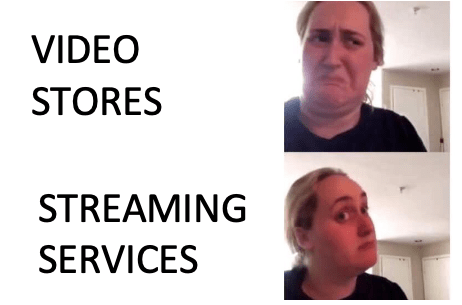
Above is a meme I created to show how much times have changed. I remember vividly when I was a kid, my family going to the video store and picking out movies for us to watch that week. It was so exciting and a social event because we used to be regulars and became friends with the owner of the video store (despite my brother ending up working there for 5 years).

It used to be such a fun experience going to the video store and binge culture didn’t really exist because we were so limited to what and how much we could watch but now with streaming services such as Netflix and Stan, viewers are watching more than ever before and video stores don’t even exist. It’s crazy to think that one day my kids won’t even visit a video store … like that’s weird.

Through the rise of media and the advancements of technologies all of out attention is so focused to what is happening on our screens. You can go onto Facebook or Instagram and within a couple of minutes I have learnt what Sally had for lunch today, Brendan’s new soccer shoes, Jacksons second girlfriend of the week and Kates workout routine. All of my attention has been focused on my screen and I already have an abundance of information – hence attention economy.

Maybe this week lets put our phones down and see what colour the trees are.

Until Next Time, R.

Critical Self-Reflection of Comments

Katie Scragg – Mario Kart Phenomenon

Katie’s DA is about the Mario Kart culture and she will be playing the game and uploading Tik Toks of her doing so. I really liked reading up about her idea and thought her pitch was super informative and factual as I genuinely learnt so much. I had no idea that Mario Kart was its own culture.

My comment on Katie’s pitch was reiterating the fact that her pitch was super informative and how and why Tik Tok is a great platform for her to use. I also suggested her to potentially use other platforms such as YouTube to reach to even more of an audience for those who don’t have Tik Tok (even though everybody does now). I also suggested that Katie live stream her playing the game as I feel her audience will be super into that as Mario Kart is such a fun and interactive game and there is so much to talk about during and after playing the game. I also linked an article I found on more background information about Mario Kart so that Katie is super informed with her game media and can understand fully the game she is playing and looking into.

Michaela Shales – Gender Sexualisation in Games

Michaela’s DA idea truly got me thinking. Basically, her idea is to play the mobile app game ‘Episode’ and analyse it by looking at the gender sexualisation of the characters, more specifically the females. This pitch got me thinking about how important it is to look at this aspect of life with global societal issues because simple things such as video games has more of an impact on us than we realise when it comes to this sort of thing.

The comment I left on Michaela’s post spoke about my views on the topic. I thought it was super relevant for me to do so as it shows that she does have an audience and that her pitch gets people thinking about what she is talking about. I also thought that her uploading these videos of her playing the game to YouTube is a really good idea as it is the best way to engage with this type of audience, as I too, watched the example and inspiration behind her DA idea. I linked a PDF file to some information on the undermining of females in video games which I found really interesting and is relevant to her idea.

Lydia McGahey – Positive Impacts of Games

Lydia’s idea is something different that I would never have come up with. Her idea is to interview her friends and others to talk about the positive effects that video games have on them and things such as their personality, beliefs etc. I think this idea is so interesting and a really important thing to consider. I think we don’t realise how much of an effect things such as video games have on us, whether that be positive or negative.

My comment on Lydia’s post spoke on my views of what her idea is and that maybe she could not only talk about the positives but also the negatives. I suggested that she could also look at people of a younger age as well as the age group she has requested as that way she can compare the effects of video games when they first came out to video games now that they have evolved so much. I also linked her to an article about the effects video games have on sleeping as this is another aspect of our lives that she could look into with her interviews.

Overall:

My 3 comments contributed to the above pitches as I gave my views on the topic and gave other suggestions on how to expand their DA ideas. I gave relevant links of which I found interesting to show them the types of things their audience will be into when looking and following their DA. I think I could be more engaging with my comments by possibly suggesting more things, such as other games or maybe even books rather than only articles.

I learnt so much about all 3 areas that I read up about when commenting and what I liked most about all 3 pitches and ideas is that they all got me thinking about the topics. I truly cared and was interested in what they were talking about which just shows the relevance of their ideas and how well it is being received. Not only did I learn so much about their topics but I also was thinking about my own views when it came to their DA ideas. Therefore, out of this experience I learnt a lot and found out that I am interested in more areas of life than I thought.

~ R.

Research Pitch

This semester for my ethnographic research, I will be researching into journaling and diminishing the stereotype around ‘journaling is for 12 year old girls’.

It has come to my attention that many academics find there is so much to gain from a journaling journey. Journals keep one’s mind working and always thinking and reflecting. It helps one to not only remember and understand their life as a whole but also helps students remember important information that they need. It extends an individual’s self-awareness which is a great way to improve your quality of life.

Also, the benefits of journaling are incredible. Once you remove the stigma of what you think journaling is, you will slowly see your life improve once starting a journaling journey. Although there are countless mental benefits, there is also so many physical benefits which even include boosting your immune system.

As my main method of research is participation observation, I am fully aware that a bias end result may occur. To lower the risk of this in my final findings, I will be comparing my results in the participation to secondary research of scholarly articles and other sources. Not only this, as I will be asking fellow students and online participants poll-based questions for my quantitative data, this will be done in hopes to balance out the bias in my final result.

Every answer will be anonymous, besides my personal experience as I truly want the end result of this research to reflect the raw emotions that journaling is all about. If no emotion come about through this research, I still would like the end result to have a personal feel to it as I find journaling to be such a personal journey.

This is why I have decided for the Digital Artefact to be a blog post. When I write and read blog posts, I feel as though it is a time for the writer to truly connect with their audience and that is the whole purpose of this research. As my original media niche is wellbeing/lifestyle influencers, they share their personal life to their audience just like I want to mine. If I think my findings appear to not be portrayed correctly as a blog post, I will consider other options such as an audio log or YouTube video.

Until Next Time, R.

References

Tank, A., 2020. This Is How Journaling Can Make You A More Effective Leader. [online] Fast Company. Available at: https://www.fastcompany.com/90423383/the-benefits-of-journaling-for-leaders <Accessed 28 August 2020>

O’Connell, T, 2011, The Case of Reflective Journals: Is the jury still out? [online PDF download], Research Gate. Available At: https://www.researchgate.net/publication/232947360_The_case_of_reflective_journals_Is_the_jury_still_out <Accessed 28 August 2020>

Purcell, M, 2020, ‘The Health Benefits of Journaling’, viewed 19 August 2020, < https://psychcentral.com/lib/the-health-benefits-of-journaling/ >

Daymon Christine and Holloway Immy (2011) ‘Ethnography’, Qualitative Research Methods in Public Relations and Marketing Communications. Routledge: New York. viewed 19 August 2020

Socially Abnormal

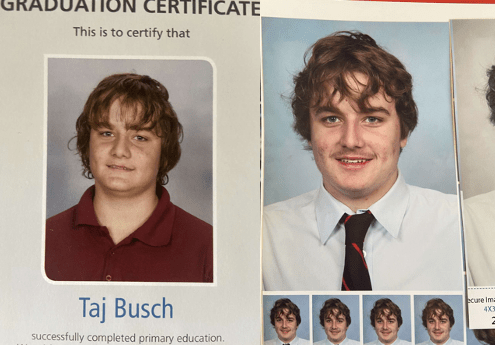
13 Years of Schooling is not only good for education, but also for forming lifelong friendships. Taj, diagnosed with Aspergers Syndrome, was bullied through Primary School and decided to change his mindset transitioning into High School in order to start making friends.

In: “For me, primary school was a pretty hard time in my life.”

Out: “… and learnt a lot more about myself and correct a lot of the wrongs that I was making.”

Ruby Reviews – Pitch

Continuing on from the attached video, this digital artefact will be highly relevant to users as if the audience of a game show wishes to read about the show, my blog will have the information for that. Not only this but individuals who want to watch a particular game show and doesn’t know if they will like it, my blog posts will provide information for that. I also intend to utilise my twitter account and ask fellow students what game shows they recommend me watch and review, this way my digital artefact is staying relevant.

“Consider the game show platform, a legendary popular culture phenomenon that blurs the boundaries between entertainment and promotion possibly better than any other medium.”

In Stephen J. Goul and Pola B. Gupta’s ‘Come on Down’ paper on Game shows and product placement, the article discusses how game shows differ from every other type of show. As these shows are not scripted and put their contestants on the spot, the audience views contenders as ‘real people’ and therefore enables them to truly indulge in the game rather than wondering who scripted what.

“Once you cause somebody at home to talk to the set aloud, even by himself or herself, then you’ve got a good game show.” – Bob Stewart.

Bob Stewart was the inventor of video games and his first game was ‘The Price is Right’. His fans and audience described his games as communication games as the ones showcased were mostly for people to say one word or even talk about.

The first of game shows were quiz shows and through the decades, turned into game shows that veered away from just quizzing contestants. Game shows such as Family Feud, Minute to Win it, Have You Been Paying Attention, Talkin’ Bout Your Generation are extended versions of the original quiz shows. However, shows such as Big Brother, Survivor, The Amazing Race, My Kitchen Rules, House Rules or even Australian Idol, have extended the views and definition of a game show. Nowadays, Bachelor in Paradise is under the ‘game show’ category, what happened to just finding love on national television? Crazy.

– R.

Liquid Life

made with GIPHY

The term “Liquid Life’ essentially means “a precarious life, lived under conditions of constant uncertainty.”

This isn’t just about life itself, but more the working life style. I will be basing this blog post more off Deuze, M. (2006) ‘Liquid Life, Convergence Culture, and Media Work’.

Today’s society is based around the balance of work/social life but individuals seem to be so stuck in their working worlds that we often forget that maybe we aren’t ‘living our best lives.’ When I say this I mean that we are so focused and centred around working, staying employed and continually making decisions which will help our future that we forget about our ‘now’.

We go to school to go to Uni to find a better paying job. Or, we leave school early to start our working lives before our friends and be ‘ahead of the game’. We are so centred around the notion of working our whole lives when really there is this massive uncertainty of where work will take us or where our next employment will come from.

“Work comes in many different shapes and sizes – paid and non-paid, voluntary and
employed, professional and amateuristic – and we seem to be engulfed in it all of the time.”

I feel that most Communication and Media students feel the angst of uncertainty when it comes to employment because of the various fields we are able to be apart of after we finish and not having one simple direction. Personally, this isn’t worrying me at the moment, I am here because it is interesting to me and I know it will be helpful for my future at some point.

Whatever will be, will be, R.

Pitch: The Daily Journal

With all the stress of the global pandemic and the constant information fed to us by the government over the year of 2020, I have decided to create The Daily Journal.

The Daily Journal, will be my Digital Artefact for BCM 206. This artefact is dedicated to individuals who wish to start (or already do) a self-care activity everyday. More specifically, journaling. I gave into the Instagram advertisements and bought The Routine’s journal, Questions for Myself and throughout this semester I intend to fill it out.

Week by week, I will write and upload about my journaling progress, speaking of the pros and cons. Not only this, but I will be engaging more with an audience on Reddit through the subreddit R/Journaling and discuss various forms of journaling while finding prompts and other information.

I want this space to be an escape from the negative information from the world and for someone to take 5 minutes out of their day and dedicate it to self-care in a creative way.

I’m excited to start this journey, R.

Civilization of the Mind

This week, Ted spoke more on understanding the network society paradigm which is dependent on informational communication technologies.

Animated GIF - Find & Share on GIPHY
made with giphy

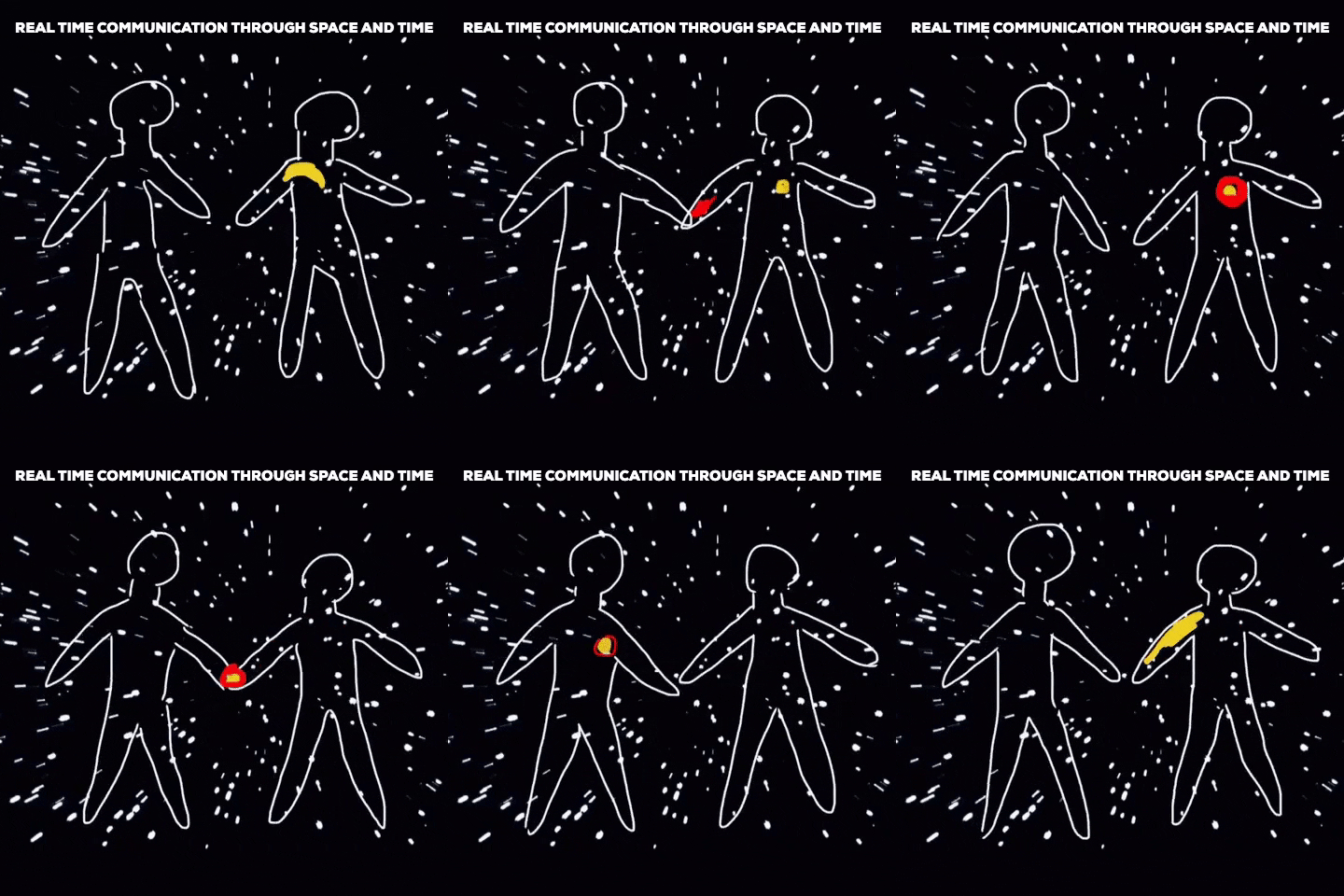
My remediation this week, resembles the role of ICT, that can send real time communication through great distance. This real time ICT was formed as a result of a ‘ripple effect’ situation where one communication technology, led to all communication technologies that we know of today.

Another side to Ted’s lecture this week, was all about Cyberspace. Something major that stood out to me was John Perry Barlow’s, Declaration of the Independence of Cyberspace. Barlow wrote out an email on February 8, 1996 about cyberspace and what he believed about the Internet. This was that the government can’t and won’t control the internet. Below is a powerful quote from the declaration.

“We have no elected government, nor are we likely to have one, so I address you with no greater authority than that with which liberty itself always speaks. I declare the global social space we are building to be naturally independent of the tyrannies you seek to impose on us.” – John Perry Barlow.

~ Until Next Time, R.

Where the Internet Began

Animated GIF - Find & Share on GIPHY
made with Giphy


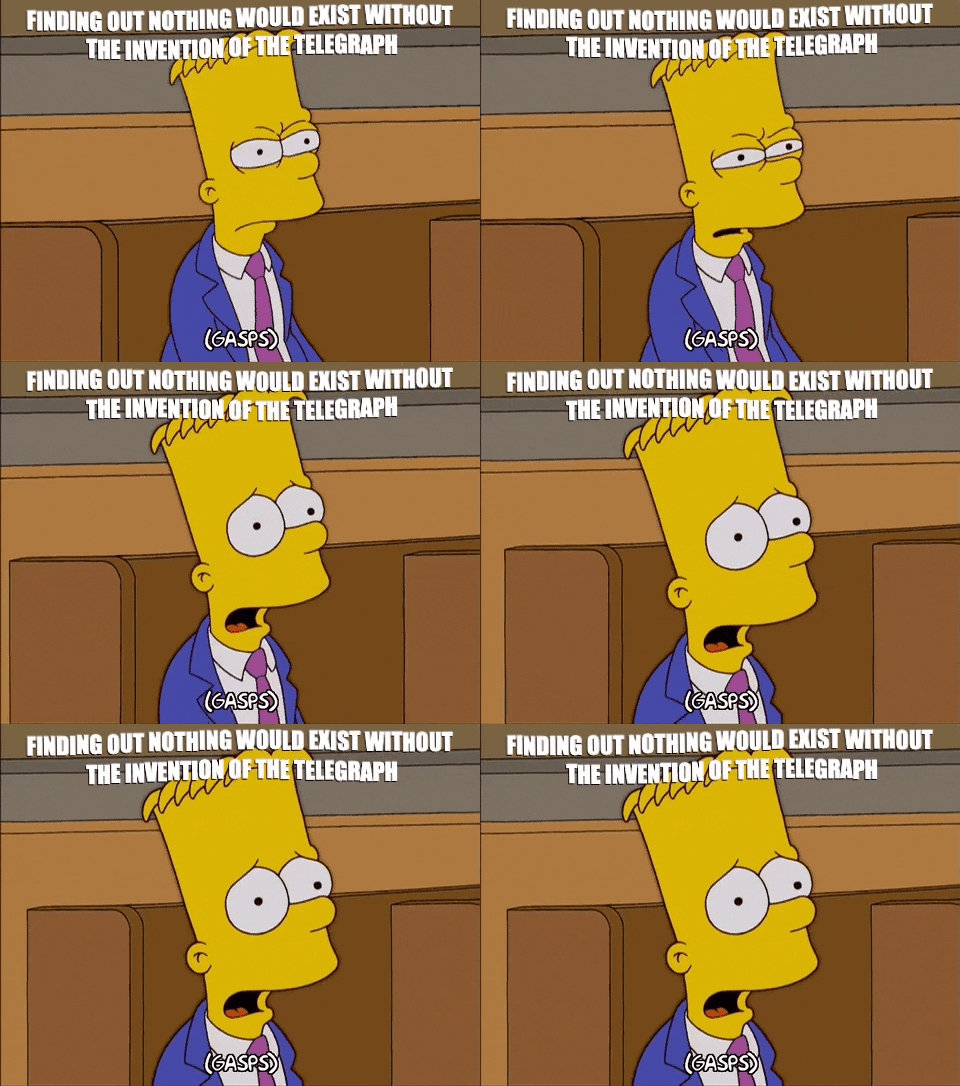
Learning about how the telegraph opened up the world is kind of inspiring.

Basically, in the 1800s Samuel Morse invented the telegraph, because, after
receiving bad news about his wife, he was unable to communicate fast enough to
be there for her. And so, he dedicated the rest of his life to fast
communication. And boy did he open up a new world.

The telegraph appeared to be complicated for personal use, so multiple
inventions were then created. One of these being, the radio. When the radio was
invented, so was the living room. How does this happen from one invention? The
telegraph literally was a growing point in the lives of individuals all over
the globe. Literally creating the living room in each household for families to
listen to entertainment and news all came about because Samuel Morse had a
goal. Real life communication. Before we knew it, the world became a nervous
system.

When I say this, I mean everything was connected by these ‘mystical’ wires
that enabled the world to connect with each other like never before. It was
mystical because people couldn’t physically see the connections but they knew
it was there, yet so foreign to them. Literally looking and acting like a human
body’s nervous system.

And that, is how the internet began.

Until Next Time, R.

214 Contextual Statement

“Social innovation refers to new ideas that work in meeting social goals.” Pol, E and Ville 2009 Social Innovation. This was the quote that formed the foundation of our app Hide and Seek. My group wanted to create something that was not only relevant for our age group but that was also benefiting a niche market. This is why Hide and Seek has so many features.

These features portray convergence culture. Henry Jenkins describes convergence as “the flow of content across multiple media platforms, the cooperation between multiple media industries and the migratory behaviour of media audiences who would go almost anywhere in search of the kinds of entertainment experiences they wanted.” Convergence culture is the combination of multiple media platforms into one, which creates an easier platform for one to use. It is the emerging of different forms of media to enhance technology and social media. Hide and Seek aims to better enhance the health, safety and social goals of festival goers.

We came up with this idea by discussing what part of festivals really make the experience difficult and then formed a solution to these problems. The first one, and most major one for all festival goers, is the lack of reception at the event which, after much research we decided to use Facebook Aquila Drone service. This enables our app to differ from other media platforms which may also cause digital disruption. The reason for this is as our app has no connection issues, we are placed at a higher level to other media platforms that heavily rely on internet connection, 4G and 5G.

Other issues we came across was losing friends at the event, injuring yourself and trying to find a safe ride home after the festival has ended. This is where the mapping aspect to our app comes into play. The map on this app is a live app that not only allows users to find their way around the festival but also track their friends, so they know their whereabouts. On top of this, the QR coding system enables users to send codes to emergency services to help an injured individual or someone in danger at the festival. Also, the message, call and video aspects of the app ensure that communication at the festival is seamless without the hassle of wondering if the connection will fail halfway through a call or text. Not only this but to actually attend the festival, a ticket must be purchased and so to really tie the app together we decided on having a ticket storage function. We truly believe that this function really brings the whole app together and achieves our goal of creating a space where all festival needs are in the one area and so there is no need to go from one app to another.

Overall, I truly believe that my group has created something that we are all really proud of. The app has enabled us to solve a social problem and has achieved goals of meeting health, safety and social needs. We really tried to guarantee that the app was realistic yet never heard of before.

REFERENCES

Jenkins, H. 2006, ‘Welcome to Convergence Culture’, Henry Jenkins Blog,

http://henryjenkins.org/blog/2006/06/welcome_to_convergence_culture.html [accessed 16 June 2020]

Jenkins, H. 2006, ‘Convergence Culture’, MediaWiki

https://mediawiki.middlebury.edu/MIDDMedia/Convergence_Culture [accessed 16 June 2020]

Losinno, R. Pickering, S. Schembri, C. Smith, H. 2020, ‘Hide and Seek’, Google Forms,

https://docs.google.com/presentation/d/1UxIKHrtz3qpS7gQuxOCnTbzj6TZMzbWh_RbHVAtQFj4/edit#slide=id.g730da0deea_2_6

[accessed 16 June 2020]

Rouse, M. 2019, ‘Digital Disruption’, Tech Target Network,

https://searchcio.techtarget.com/definition/digital-disruption [accessed 16 June 2020]