Having my media niche fit into the realm of lifestyle, more specifically wellbeing opens me up to a lot of different ways to approach this subject. Narrowing this down however has been quite easy for me, lately I have been so intrigued by the notion and idea of journaling. When researching into journaling, it feels like a whole new world and perspective on life, both what I like to be seeing. So, through this, I made a mind map connecting journaling to different field sites.
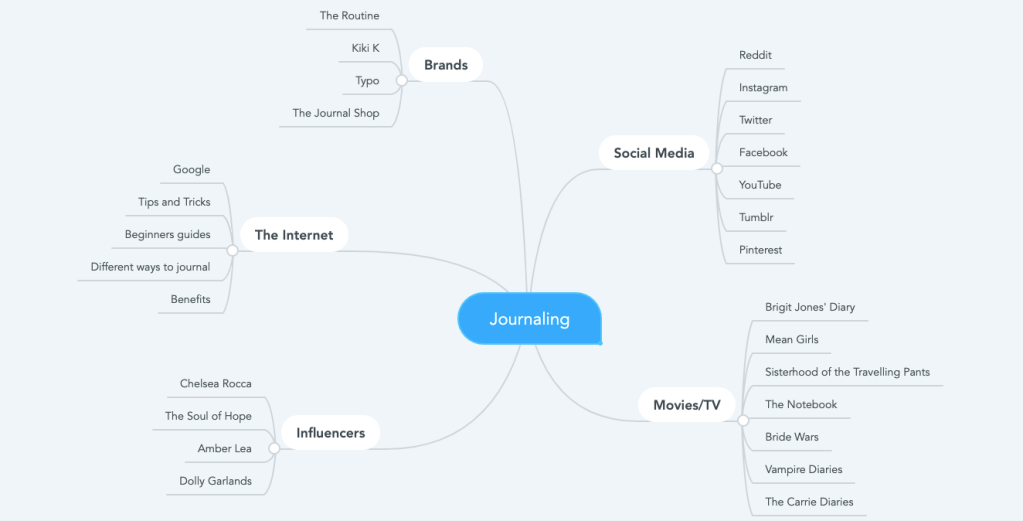
To understand this mind map, I will talk about what a field site is. Basically a field site is not one specific place or thing, it is a range of different places, people, things, sites etc that hold any type of information or connection to a certain niche. Because we are looking at this niche in an ethnographic frame of mind, we must also understand what ethnographic research is. Let’s break it down.
Ethnographic research: “The study of the culture and social organisation of a particular group or community … Ethnography refers to both the data gathering of anthropology and the development of analysis of specific peoples, settings or ways of life.” Studying ethnographically means to truly understand one particular group, community or concept and this then involves participating or observing that specific area. The whole idea of it, is to truly understand a problem and come up with a better solution to fix this. Therefore, with my media niche circulating around journaling, I intend to begin my own personal journaling journey and truly seek its benefits. Are there any? How come they are there? Why is being in touch with your emotions so important to understanding yourself? How does one simple act create such a large impact?
Field Site: This involves anything to do with a certain area of interest. Whether that be people involved, branding, places to find it, media sites, physical and non physical places, products … anything at all. Therefore, as seen above I have narrowed down some field sites connected to journaling. I placed them into headings and branched off more specific from there. These are all places/people/products that I have found since slightly touching on researching further into the spectrum of journaling.
People who might be interested in my niche are people who have similar interests to me, such as lifestyle and wellbeing content. Not only this but people who regularly journal, no matter the form they choose to do this.
I bring a new perspective to this area of study. The reason simply being I haven’t done it before and want to and will learn as I go. I am interested in this aspect of life as I want to better my wellbeing by doing simple things daily, and it appears that journaling has a world of its own. I want to learn about this world, this community and society of people who share a common interest and see what else they have in common. Is there a negative connotation based around keeping a journal?
There are multiple articles stating the benefits of journaling on mental and physical health. These include reducing stress, improving immune functions, memory improvements, mood booster and strengthening emotional functions. This is fascinating to me, how does it help someone so much though? Well, by prioritising your problems, fears and emotions you are allowing yourself to face them properly, understand them and let them go. It also allows room for more positive self talk and that is something that is highly underrated. As our minds are constantly thinking whether we are aware of it or not, it is important that for the most part these thoughts are in a positive mood and attitude.
All in all, furthering research in journaling with an ethnographic approach appears, to me, to be the best way to truly understand this niche and try solve the stigma around ‘keeping a journal is for 12 year old girls’.
Stay True, R.
[Edit 03 September 2020 below]
References
Calhoun, C. J. (2002). Dictionary of the social sciences. New York: Oxford University Press viewed 14 August 2020
Unknown, 2020, ‘Fieldsite’, viewed 14 August 2020 < https://www.yourdictionary.com/fieldsite#:~:text=(plural%20fieldsites),where%20fieldwork%20is%20carried%20out. >
Leo, 2018, ‘The 17 Different Types of Journals that will Keep your Life Organised’, viewed 14 August 2020, < https://www.jofelo.com/17-different-types-of-journals-to-keep/ >
Bailey, K, 2018, 5 Powerful Health Benefits of Journaling, viewed 14 August 2020, < https://intermountainhealthcare.org/blogs/topics/live-well/2018/07/5-powerful-health-benefits-of-journaling/ >
Watson, R, 2020, ‘Journaling for Mental Health’, viewed 14 August 2020, < https://www.urmc.rochester.edu/encyclopedia/content.aspx?ContentID=4552&ContentTypeID=1#:~:text=Journaling%20helps%20control%20your%20symptoms,and%20identifying%20negative%20thoughts%20and >
Hartwell-Walker, M, 2018, ‘Writing for Health, viewed 14 August 2020, < https://psychcentral.com/lib/writing-for-health/ >


 immerse into media