Research Pitch

This semester for my ethnographic research, I will be researching into journaling and diminishing the stereotype around ‘journaling is for 12 year old girls’.

It has come to my attention that many academics find there is so much to gain from a journaling journey. Journals keep one’s mind working and always thinking and reflecting. It helps one to not only remember and understand their life as a whole but also helps students remember important information that they need. It extends an individual’s self-awareness which is a great way to improve your quality of life.

Also, the benefits of journaling are incredible. Once you remove the stigma of what you think journaling is, you will slowly see your life improve once starting a journaling journey. Although there are countless mental benefits, there is also so many physical benefits which even include boosting your immune system.

As my main method of research is participation observation, I am fully aware that a bias end result may occur. To lower the risk of this in my final findings, I will be comparing my results in the participation to secondary research of scholarly articles and other sources. Not only this, as I will be asking fellow students and online participants poll-based questions for my quantitative data, this will be done in hopes to balance out the bias in my final result.

Every answer will be anonymous, besides my personal experience as I truly want the end result of this research to reflect the raw emotions that journaling is all about. If no emotion come about through this research, I still would like the end result to have a personal feel to it as I find journaling to be such a personal journey.

This is why I have decided for the Digital Artefact to be a blog post. When I write and read blog posts, I feel as though it is a time for the writer to truly connect with their audience and that is the whole purpose of this research. As my original media niche is wellbeing/lifestyle influencers, they share their personal life to their audience just like I want to mine. If I think my findings appear to not be portrayed correctly as a blog post, I will consider other options such as an audio log or YouTube video.

Until Next Time, R.

References

Tank, A., 2020. This Is How Journaling Can Make You A More Effective Leader. [online] Fast Company. Available at: https://www.fastcompany.com/90423383/the-benefits-of-journaling-for-leaders <Accessed 28 August 2020>

O’Connell, T, 2011, The Case of Reflective Journals: Is the jury still out? [online PDF download], Research Gate. Available At: https://www.researchgate.net/publication/232947360_The_case_of_reflective_journals_Is_the_jury_still_out <Accessed 28 August 2020>

Purcell, M, 2020, ‘The Health Benefits of Journaling’, viewed 19 August 2020, < https://psychcentral.com/lib/the-health-benefits-of-journaling/ >

Daymon Christine and Holloway Immy (2011) ‘Ethnography’, Qualitative Research Methods in Public Relations and Marketing Communications. Routledge: New York. viewed 19 August 2020
Research and Ethics

Throughout my research this semester, the paradigmatic and theoretical framework I will be using are mostly social media and its users. More specifically, I intend to post and analyse on Reddit and Twitter and analysing on Instagram and YouTube. The reason for this being that I find Reddit and Twitter to be platforms where engagement is extremely high and so through this I will be able to better understand journaling and research further into its problematisation. I will also be analysing more Instagram and YouTubers as influencers I follow that journal post regularly about their journeys and so I can engage more with this to see another side to journaling and researching. Not only this, but through The Routine’s journal ‘Questions for Myself’, I will be starting a journal of my own and see if it changes my life and mental wellbeing in any way. This way, I am fully immersing myself into the culture and society of journaling.

Reflective journals are defined as ‘… written documents that students create as they
think about various concepts, events, or interactions over a period of time for the
purposes of gaining insights into self-awareness and learning’
. The article hyperlinked explains the relationship between reflective journals and students. Many academics find there is much to gain from journaling and this is why the frameworks I have chosen to work with will better my understanding and my audience’s understanding of journaling. It essentially is saying that journals are a great food for thought and keep the student remembering facts and information given to them. Not only this but it allows them to write down – or illustrate – things that happen to them through the course of their life and this throws them into self-awareness and understanding ones self.

Another article written by Fast Company also shows the benefits of journaling. This article shows that once the stereotype of journaling is removed, the benefits are tremendous. This is even including boosting your immune system. Staying in tune and understanding your emotions has all these scientific benefits and what I want to do, through my ethnographic research of the chosen frameworks, is diminish the stereotype and showcase the benefits of journaling.

Through using scholarly articles and social media with my ethnographic research I will most definitely stumble across multiple ethical issues that I plan to avoid.

Ethical issues that I expect to come across are individuals names and privacy issues, bias research and being unable to correctly reference work. These issues are quite common with research as a whole but as an ethnographic researcher in this instance, it becomes a bit more difficult.

I will ensure that my audience on Twitter and Reddit know that what I am posting and asking questions about, is for research purposes and every answer will be anonymous. This will be done through blacking out of names (even though reddit is 90% anonymous anyway). When it comes to this research I can see issues arising with bias as I will be participating. In order to avoid this, I will make my final research report very clear that I have participated in my own journaling journey and so some responses to stereotypes and problems within journaling may be bias in relation to my own personal experience but I also will be ensuring that my answer varies with sources. This is why I have chosen multiple frameworks, social media, the world wide web and participation. Lastly when it comes to referencing scholarly and peer-reviewed articles I will hyperlink and Harvard reference the links to ensure that all workers rights are allocated in the correct direction.

In summary, the ethnographic research project that I will be producing, has every intention of being ethical and unbiased. Although it is in our human nature to be bias when we are in participation, I will be taking into account the secondary research conducted and weigh up the primary and secondary sources, to compare and come to a fair conclusion of research.

Until Next Time, R.

References

Tank, A., 2020. This Is How Journaling Can Make You A More Effective Leader. [online] Fast Company. Available at: https://www.fastcompany.com/90423383/the-benefits-of-journaling-for-leaders <Accessed 28 August 2020>

O’Connell, T, 2011, The Case of Reflective Journals: Is the jury still out? [online PDF download], Research Gate. Available At: https://www.researchgate.net/publication/232947360_The_case_of_reflective_journals_Is_the_jury_still_out <Accessed 28 August 2020>

Planning My Approach

Problematising

When I, personally, first think of journaling, what comes to mind is a 12 year old girl, sitting in her room writing in her diary. But, after minor research, journaling does not even come close to fitting this stereotype. Therefore, when it comes to problematising journaling, my first initial thought is to try diminish the stereotype that ‘journaling is for 12 year olds’.

“Journaling (or keeping letters or diaries) is an ancient tradition, one that dates back to at least 10th century Japan. Successful people throughout history have kept journals. Presidents have maintained them for posterity; other famous figures for their own purposes. “

After briefly doing some research and seeing the tremendous benefits journaling can have on individuals, other problems began to arise. Steven Stonsy wrote that journaling can have a negative effect on your behaviour and well-being as it can make you live too much in your own mind. Not only this, but Amber Beam also wrote on the negative effects of journaling and how to avoid these. A problem that arose from this article was that journaling can mean you are thinking too deeply into all your negative thoughts and problems and may end up being a repetitive activity where you continue to speak of the ‘bad’ that has happened to you.

As journaling can be a time for one to reflect on their life choices, events and emotions, some negative things are going to come about in all of that, it is just human nature. For most, writing them down helps with letting go and moving forward but for some it brings up old emotions that haven’t been solved yet. Journaling may also invite you to overthink your life and this is where journaling can be harmful and problematised.

Although these issues may arise when one is a regular journalor, it is not only rare but very easily avoidable. Therefore, throughout this semester I intend to ensure that others are aware of these problems and know how to avoid them or handle them if they come about.

Something that could be understood better is seeing that journaling can be for anybody and doesn’t have to be in written form. Before this semester I had no idea that an individual can journal in multiple ways. These include painting, drawing, audio, prayer, reading, travel and so much more. So, I would like to reiterate the knowledge of journaling to others and show that it really is just a ‘time out’ and doesn’t have to connect to ones deepest emotions.

Research Plan

Throughout this semester, I will be observing my niche through various social media platforms. These including, Twitter, Instagram and Youtube comment sections and a new one brought to my attention, Reddit. Through these social media platforms I will observe the individuals I am aware of that journal (influencers) and also be asking others about their journaling journeys.

Below is a quote from one of our week one readings, Daymon Christine and Holloway Immy (2011) ‘Ethnography, Qualitative Research Methods in Public Relations and Marketing Communications’.

“Ethnography is both a research methodology and the product of that research,
that is, a written description of a culture which is based on the findings of
fieldwork. Ethnographic research may be both qualitative and quantitative,
but in public relations, marketing communications and other people-focused
disciplines it is usually qualitative.”

Therefore, the approaches that I have mentioned here are all ethnographic research methods and this is why I will be truly immersing myself into the world of journaling. I would like to find out as much as I can when it comes to keeping a journal.

Are males or females more likely to journal? What’s the most popular way to journal? Why do these individuals journal?

Schedule of Research

As stated above I will be using social media to gather research for this project. I will also be conducting a thorough secondary research to seek the true benefits and disassemble the negative connotations and stereotypes based around journaling. I will also begin my own personal journaling journey.

I will be using The Routine’s journal Questions for Myself and take myself on the journey too. This meaning, I will be doing a participatory observation for my ethnographic research project.

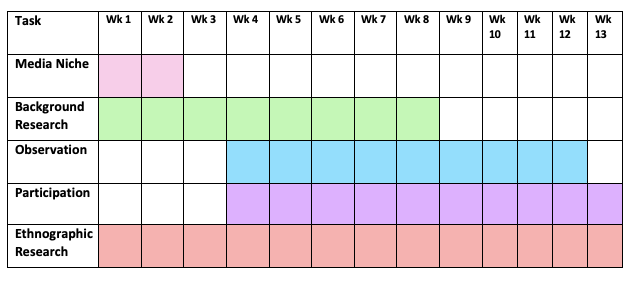
Below is a Gantt chart I created to roughly show my process of using these ethnographic research methods and methodologies.

~ R.

[Edit 03 September 2020 below]

References

Purcell, M, 2020, ‘The Health Benefits of Journaling’, viewed 19 August 2020, < https://psychcentral.com/lib/the-health-benefits-of-journaling/ >

Stonsy, S, 2013, ‘The Good and the Bad of Journaling’, viewed 19 August 2020 < https://www.psychologytoday.com/au/blog/anger-in-the-age-entitlement/201309/the-good-and-the-bad-journaling#:~:text=Journaling%20can%20have%20a%20negative,too%20much%20in%20your%20head >

Beam, A, 2020, ‘Journaling: How to Avoid Harmful Journaling Habits’, viewed 19 August 2020, < https://www.amberbeam.com/e26-bonus-journaling-part-2/ >

Hugo, 2020, ‘Can Journaling Be Harmful?’, viewed 19 August 2020, < https://www.trackinghappiness.com/can-journaling-be-harmful/ >

Daymon Christine and Holloway Immy (2011) ‘Ethnography’, Qualitative Research Methods in Public Relations and Marketing Communications. Routledge: New York. viewed 19 August 2020

Narrowing my Field Site

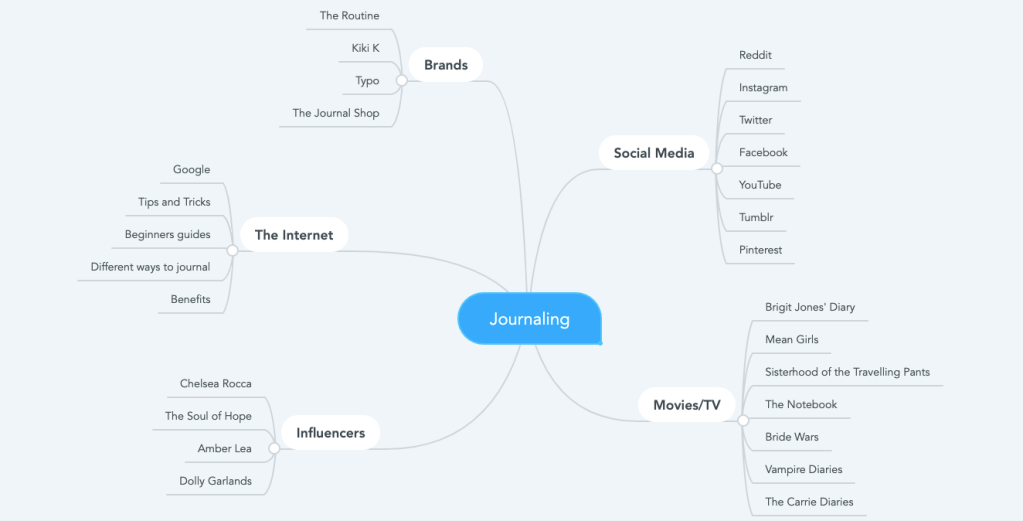
Having my media niche fit into the realm of lifestyle, more specifically wellbeing opens me up to a lot of different ways to approach this subject. Narrowing this down however has been quite easy for me, lately I have been so intrigued by the notion and idea of journaling. When researching into journaling, it feels like a whole new world and perspective on life, both what I like to be seeing. So, through this, I made a mind map connecting journaling to different field sites.

To understand this mind map, I will talk about what a field site is. Basically a field site is not one specific place or thing, it is a range of different places, people, things, sites etc that hold any type of information or connection to a certain niche. Because we are looking at this niche in an ethnographic frame of mind, we must also understand what ethnographic research is. Let’s break it down.

Ethnographic research: “The study of the culture and social organisation of a particular group or community … Ethnography refers to both the data gathering of anthropology and the development of analysis of specific peoples, settings or ways of life.” Studying ethnographically means to truly understand one particular group, community or concept and this then involves participating or observing that specific area. The whole idea of it, is to truly understand a problem and come up with a better solution to fix this. Therefore, with my media niche circulating around journaling, I intend to begin my own personal journaling journey and truly seek its benefits. Are there any? How come they are there? Why is being in touch with your emotions so important to understanding yourself? How does one simple act create such a large impact?

Field Site: This involves anything to do with a certain area of interest. Whether that be people involved, branding, places to find it, media sites, physical and non physical places, products … anything at all. Therefore, as seen above I have narrowed down some field sites connected to journaling. I placed them into headings and branched off more specific from there. These are all places/people/products that I have found since slightly touching on researching further into the spectrum of journaling.

People who might be interested in my niche are people who have similar interests to me, such as lifestyle and wellbeing content. Not only this but people who regularly journal, no matter the form they choose to do this.

I bring a new perspective to this area of study. The reason simply being I haven’t done it before and want to and will learn as I go. I am interested in this aspect of life as I want to better my wellbeing by doing simple things daily, and it appears that journaling has a world of its own. I want to learn about this world, this community and society of people who share a common interest and see what else they have in common. Is there a negative connotation based around keeping a journal?

There are multiple articles stating the benefits of journaling on mental and physical health. These include reducing stress, improving immune functions, memory improvements, mood booster and strengthening emotional functions. This is fascinating to me, how does it help someone so much though? Well, by prioritising your problems, fears and emotions you are allowing yourself to face them properly, understand them and let them go. It also allows room for more positive self talk and that is something that is highly underrated. As our minds are constantly thinking whether we are aware of it or not, it is important that for the most part these thoughts are in a positive mood and attitude.

“Smyth’s team studied 107 people with asthma and rheumatoid arthritis. He asked half the group to write for 20 minutes a day for three days about the most stressful event they could remember. The control group was asked to write about their daily plans. Four months later, 70 people in the group that wrote about their stress showed improvement. Only 37 of the control group improved.”

All in all, furthering research in journaling with an ethnographic approach appears, to me, to be the best way to truly understand this niche and try solve the stigma around ‘keeping a journal is for 12 year old girls’.

Stay True, R.

[Edit 03 September 2020 below]

References

Calhoun, C. J. (2002). Dictionary of the social sciences. New York: Oxford University Press viewed 14 August 2020

Unknown, 2020, ‘Fieldsite’, viewed 14 August 2020 < https://www.yourdictionary.com/fieldsite#:~:text=(plural%20fieldsites),where%20fieldwork%20is%20carried%20out. >

Leo, 2018, ‘The 17 Different Types of Journals that will Keep your Life Organised’, viewed 14 August 2020, < https://www.jofelo.com/17-different-types-of-journals-to-keep/ >

Bailey, K, 2018, 5 Powerful Health Benefits of Journaling, viewed 14 August 2020, < https://intermountainhealthcare.org/blogs/topics/live-well/2018/07/5-powerful-health-benefits-of-journaling/ >

Watson, R, 2020, ‘Journaling for Mental Health’, viewed 14 August 2020, < https://www.urmc.rochester.edu/encyclopedia/content.aspx?ContentID=4552&ContentTypeID=1#:~:text=Journaling%20helps%20control%20your%20symptoms,and%20identifying%20negative%20thoughts%20and >

Hartwell-Walker, M, 2018, ‘Writing for Health, viewed 14 August 2020, < https://psychcentral.com/lib/writing-for-health/ >

My Media Niche

My media niche is health and lifestyle vloggers, influencers or Youtuber’s.

When I say health and lifestyle, I specifically mean individuals who are ‘well-known’ for vlogging their day to day life, their health and fitness journey and even their mental wellbeing. Examples of the individuals I follow and watch are Sarah’s Day, Chelsea Rocca, Charlotte Freeman and Tayla Damir. These individuals all have something in common, they live each day trying to improve their mental and physical state and that is something that highly intrigues me.

https://www.youtube.com/channel/UCAHufvd02viJSRdt3ojdPOg
https://www.youtube.com/channel/UCWSksWN12Y997XdmcqVrQTg

However, when it comes to my ‘personal media niche’ mental wellbeing is what interests me most. Having a focused and positive mindset is something that every individual struggles with throughout their life and so with my media niche, I want to focus on mental wellbeing and how to maintain it as such. I would like to do this by experimenting with journaling.

https://linktr.ee/chelsrocca

In the past, I have never been one to journal religiously. I always thought it was for people with big secrets who wanted to talk about their day or someone who has a big crush. Nonetheless, research has proven that journaling increases ones mental health. I want to learn about journaling and help others learn about it too. Find out the truths, deception and most importantly the outcomes of being someone who regularly journals.

“Journaling is simply writing down your thoughts and feelings to understand them more clearly.” When researching into the benefits of journaling, the outcomes seem to be tremendous. Controlling and understanding your feelings, finding your sense of self and lessening mental disorder symptoms such as anxiety and depression. “It can make us more aware and help us detect sneaky, unhealthy patterns in our thoughts and behaviours.” This then makes us more aware of our life and enhancing our ability to control our quality of life.

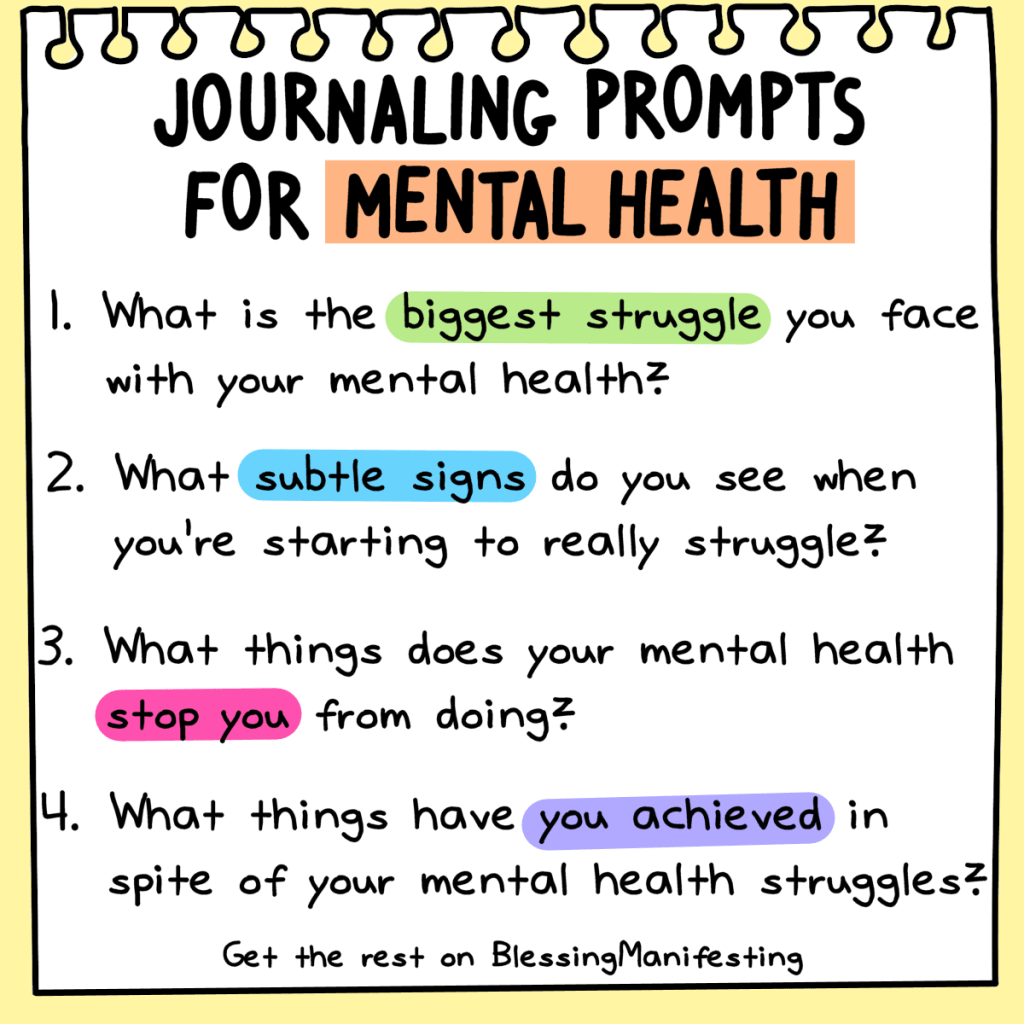
https://www.blessingmanifesting.com/2018/07/12-journaling-prompts-for-mental-health.html

Journaling appears to be its own culture and experience away from any other. There are all different types of journaling such as bullet journaling, food, travel, dream, writing and many more. All of which seem to have a positive outcome. Hayley Phelan states in a New York Times article that journaling is one of the best ways for self-care and also one of the cheapest. Setting aside 5 – 15 minutes a day to journal, ask yourself hard hitting questions, google journal prompts or writing about how you felt that day has proven to enhance thousands of individuals mental wellbeing. It is genuinely helping people.

Writing your feelings, asking yourself specific questions and writing down the answer can enhance your mental wellbeing? Count me in.

I intend to explore this in detail through extensive primary and secondary research. Instead of just finding articles and blogs about the benefits of journaling – which I will do – I will also begin to regularly journal and see where my journaling journey takes me. I have stumbled across a business named The Routine, who promotes healthy mental wellbeing. I intend to follow their ‘Questions for Myself’ journal and see if it benefits me in any way. Journaling may not be for everyone, but I feel it is relevant as it is something so simple and small that seems to have a large positive impact on self-care.

Therefore, my personal media niche is lifestyle and promoting a healthy living style.

Stay True, R.

[Edit 03 September 2020 below]

References

Watson, R, 2020, ‘Journaling for Mental Health’, viewed 5th August 2020, < https://www.urmc.rochester.edu/encyclopedia/content.aspx?ContentID=4552&ContentTypeID=1 >

Ackerman, C, 2020, ’83 Benefits of Journaling for Depression, Anxiety and Stress’ viewed 5th August 2020, < https://positivepsychology.com/benefits-of-journaling/ >

Leo, 2018, ‘The 17 Different Types of Journals That Will Keep Your Life Organised’, viewed 5th August 2020, < https://www.jofelo.com/17-different-types-of-journals-to-keep/ >

Phelan, H, 2018, ‘What’s All This About Journaling?’, viewed 5th August 2020, < https://www.nytimes.com/2018/10/25/style/journaling-benefits.html >