Research and Ethics

Throughout my research this semester, the paradigmatic and theoretical framework I will be using are mostly social media and its users. More specifically, I intend to post and analyse on Reddit and Twitter and analysing on Instagram and YouTube. The reason for this being that I find Reddit and Twitter to be platforms where engagement is extremely high and so through this I will be able to better understand journaling and research further into its problematisation. I will also be analysing more Instagram and YouTubers as influencers I follow that journal post regularly about their journeys and so I can engage more with this to see another side to journaling and researching. Not only this, but through The Routine’s journal ‘Questions for Myself’, I will be starting a journal of my own and see if it changes my life and mental wellbeing in any way. This way, I am fully immersing myself into the culture and society of journaling.

Reflective journals are defined as ‘… written documents that students create as they
think about various concepts, events, or interactions over a period of time for the
purposes of gaining insights into self-awareness and learning’
. The article hyperlinked explains the relationship between reflective journals and students. Many academics find there is much to gain from journaling and this is why the frameworks I have chosen to work with will better my understanding and my audience’s understanding of journaling. It essentially is saying that journals are a great food for thought and keep the student remembering facts and information given to them. Not only this but it allows them to write down – or illustrate – things that happen to them through the course of their life and this throws them into self-awareness and understanding ones self.

Another article written by Fast Company also shows the benefits of journaling. This article shows that once the stereotype of journaling is removed, the benefits are tremendous. This is even including boosting your immune system. Staying in tune and understanding your emotions has all these scientific benefits and what I want to do, through my ethnographic research of the chosen frameworks, is diminish the stereotype and showcase the benefits of journaling.

Through using scholarly articles and social media with my ethnographic research I will most definitely stumble across multiple ethical issues that I plan to avoid.

Ethical issues that I expect to come across are individuals names and privacy issues, bias research and being unable to correctly reference work. These issues are quite common with research as a whole but as an ethnographic researcher in this instance, it becomes a bit more difficult.

I will ensure that my audience on Twitter and Reddit know that what I am posting and asking questions about, is for research purposes and every answer will be anonymous. This will be done through blacking out of names (even though reddit is 90% anonymous anyway). When it comes to this research I can see issues arising with bias as I will be participating. In order to avoid this, I will make my final research report very clear that I have participated in my own journaling journey and so some responses to stereotypes and problems within journaling may be bias in relation to my own personal experience but I also will be ensuring that my answer varies with sources. This is why I have chosen multiple frameworks, social media, the world wide web and participation. Lastly when it comes to referencing scholarly and peer-reviewed articles I will hyperlink and Harvard reference the links to ensure that all workers rights are allocated in the correct direction.

In summary, the ethnographic research project that I will be producing, has every intention of being ethical and unbiased. Although it is in our human nature to be bias when we are in participation, I will be taking into account the secondary research conducted and weigh up the primary and secondary sources, to compare and come to a fair conclusion of research.

Until Next Time, R.

References

Tank, A., 2020. This Is How Journaling Can Make You A More Effective Leader. [online] Fast Company. Available at: https://www.fastcompany.com/90423383/the-benefits-of-journaling-for-leaders <Accessed 28 August 2020>

O’Connell, T, 2011, The Case of Reflective Journals: Is the jury still out? [online PDF download], Research Gate. Available At: https://www.researchgate.net/publication/232947360_The_case_of_reflective_journals_Is_the_jury_still_out <Accessed 28 August 2020>
Planning My Approach

Problematising

When I, personally, first think of journaling, what comes to mind is a 12 year old girl, sitting in her room writing in her diary. But, after minor research, journaling does not even come close to fitting this stereotype. Therefore, when it comes to problematising journaling, my first initial thought is to try diminish the stereotype that ‘journaling is for 12 year olds’.

“Journaling (or keeping letters or diaries) is an ancient tradition, one that dates back to at least 10th century Japan. Successful people throughout history have kept journals. Presidents have maintained them for posterity; other famous figures for their own purposes. “

After briefly doing some research and seeing the tremendous benefits journaling can have on individuals, other problems began to arise. Steven Stonsy wrote that journaling can have a negative effect on your behaviour and well-being as it can make you live too much in your own mind. Not only this, but Amber Beam also wrote on the negative effects of journaling and how to avoid these. A problem that arose from this article was that journaling can mean you are thinking too deeply into all your negative thoughts and problems and may end up being a repetitive activity where you continue to speak of the ‘bad’ that has happened to you.

As journaling can be a time for one to reflect on their life choices, events and emotions, some negative things are going to come about in all of that, it is just human nature. For most, writing them down helps with letting go and moving forward but for some it brings up old emotions that haven’t been solved yet. Journaling may also invite you to overthink your life and this is where journaling can be harmful and problematised.

Although these issues may arise when one is a regular journalor, it is not only rare but very easily avoidable. Therefore, throughout this semester I intend to ensure that others are aware of these problems and know how to avoid them or handle them if they come about.

Something that could be understood better is seeing that journaling can be for anybody and doesn’t have to be in written form. Before this semester I had no idea that an individual can journal in multiple ways. These include painting, drawing, audio, prayer, reading, travel and so much more. So, I would like to reiterate the knowledge of journaling to others and show that it really is just a ‘time out’ and doesn’t have to connect to ones deepest emotions.

Research Plan

Throughout this semester, I will be observing my niche through various social media platforms. These including, Twitter, Instagram and Youtube comment sections and a new one brought to my attention, Reddit. Through these social media platforms I will observe the individuals I am aware of that journal (influencers) and also be asking others about their journaling journeys.

Below is a quote from one of our week one readings, Daymon Christine and Holloway Immy (2011) ‘Ethnography, Qualitative Research Methods in Public Relations and Marketing Communications’.

“Ethnography is both a research methodology and the product of that research,
that is, a written description of a culture which is based on the findings of
fieldwork. Ethnographic research may be both qualitative and quantitative,
but in public relations, marketing communications and other people-focused
disciplines it is usually qualitative.”

Therefore, the approaches that I have mentioned here are all ethnographic research methods and this is why I will be truly immersing myself into the world of journaling. I would like to find out as much as I can when it comes to keeping a journal.

Are males or females more likely to journal? What’s the most popular way to journal? Why do these individuals journal?

Schedule of Research

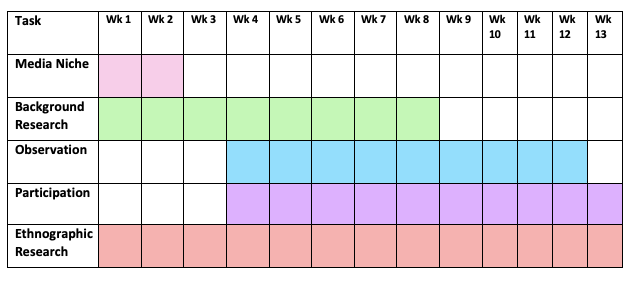
As stated above I will be using social media to gather research for this project. I will also be conducting a thorough secondary research to seek the true benefits and disassemble the negative connotations and stereotypes based around journaling. I will also begin my own personal journaling journey.

I will be using The Routine’s journal Questions for Myself and take myself on the journey too. This meaning, I will be doing a participatory observation for my ethnographic research project.

Below is a Gantt chart I created to roughly show my process of using these ethnographic research methods and methodologies.

~ R.

[Edit 03 September 2020 below]

References

Purcell, M, 2020, ‘The Health Benefits of Journaling’, viewed 19 August 2020, < https://psychcentral.com/lib/the-health-benefits-of-journaling/ >

Stonsy, S, 2013, ‘The Good and the Bad of Journaling’, viewed 19 August 2020 < https://www.psychologytoday.com/au/blog/anger-in-the-age-entitlement/201309/the-good-and-the-bad-journaling#:~:text=Journaling%20can%20have%20a%20negative,too%20much%20in%20your%20head >

Beam, A, 2020, ‘Journaling: How to Avoid Harmful Journaling Habits’, viewed 19 August 2020, < https://www.amberbeam.com/e26-bonus-journaling-part-2/ >

Hugo, 2020, ‘Can Journaling Be Harmful?’, viewed 19 August 2020, < https://www.trackinghappiness.com/can-journaling-be-harmful/ >

Daymon Christine and Holloway Immy (2011) ‘Ethnography’, Qualitative Research Methods in Public Relations and Marketing Communications. Routledge: New York. viewed 19 August 2020