Planning My Approach

Problematising

When I, personally, first think of journaling, what comes to mind is a 12 year old girl, sitting in her room writing in her diary. But, after minor research, journaling does not even come close to fitting this stereotype. Therefore, when it comes to problematising journaling, my first initial thought is to try diminish the stereotype that ‘journaling is for 12 year olds’.

“Journaling (or keeping letters or diaries) is an ancient tradition, one that dates back to at least 10th century Japan. Successful people throughout history have kept journals. Presidents have maintained them for posterity; other famous figures for their own purposes. “

After briefly doing some research and seeing the tremendous benefits journaling can have on individuals, other problems began to arise. Steven Stonsy wrote that journaling can have a negative effect on your behaviour and well-being as it can make you live too much in your own mind. Not only this, but Amber Beam also wrote on the negative effects of journaling and how to avoid these. A problem that arose from this article was that journaling can mean you are thinking too deeply into all your negative thoughts and problems and may end up being a repetitive activity where you continue to speak of the ‘bad’ that has happened to you.

As journaling can be a time for one to reflect on their life choices, events and emotions, some negative things are going to come about in all of that, it is just human nature. For most, writing them down helps with letting go and moving forward but for some it brings up old emotions that haven’t been solved yet. Journaling may also invite you to overthink your life and this is where journaling can be harmful and problematised.

Although these issues may arise when one is a regular journalor, it is not only rare but very easily avoidable. Therefore, throughout this semester I intend to ensure that others are aware of these problems and know how to avoid them or handle them if they come about.

Something that could be understood better is seeing that journaling can be for anybody and doesn’t have to be in written form. Before this semester I had no idea that an individual can journal in multiple ways. These include painting, drawing, audio, prayer, reading, travel and so much more. So, I would like to reiterate the knowledge of journaling to others and show that it really is just a ‘time out’ and doesn’t have to connect to ones deepest emotions.

Research Plan

Throughout this semester, I will be observing my niche through various social media platforms. These including, Twitter, Instagram and Youtube comment sections and a new one brought to my attention, Reddit. Through these social media platforms I will observe the individuals I am aware of that journal (influencers) and also be asking others about their journaling journeys.

Below is a quote from one of our week one readings, Daymon Christine and Holloway Immy (2011) ‘Ethnography, Qualitative Research Methods in Public Relations and Marketing Communications’.

“Ethnography is both a research methodology and the product of that research,
that is, a written description of a culture which is based on the findings of
fieldwork. Ethnographic research may be both qualitative and quantitative,
but in public relations, marketing communications and other people-focused
disciplines it is usually qualitative.”

Therefore, the approaches that I have mentioned here are all ethnographic research methods and this is why I will be truly immersing myself into the world of journaling. I would like to find out as much as I can when it comes to keeping a journal.

Are males or females more likely to journal? What’s the most popular way to journal? Why do these individuals journal?

Schedule of Research

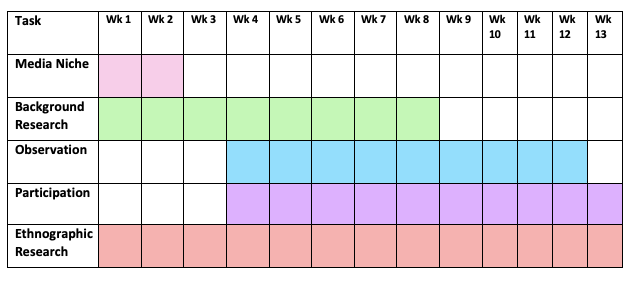
As stated above I will be using social media to gather research for this project. I will also be conducting a thorough secondary research to seek the true benefits and disassemble the negative connotations and stereotypes based around journaling. I will also begin my own personal journaling journey.

I will be using The Routine’s journal Questions for Myself and take myself on the journey too. This meaning, I will be doing a participatory observation for my ethnographic research project.

Below is a Gantt chart I created to roughly show my process of using these ethnographic research methods and methodologies.
~ R.

[Edit 03 September 2020 below]

References

Purcell, M, 2020, ‘The Health Benefits of Journaling’, viewed 19 August 2020, < https://psychcentral.com/lib/the-health-benefits-of-journaling/ >

Stonsy, S, 2013, ‘The Good and the Bad of Journaling’, viewed 19 August 2020 < https://www.psychologytoday.com/au/blog/anger-in-the-age-entitlement/201309/the-good-and-the-bad-journaling#:~:text=Journaling%20can%20have%20a%20negative,too%20much%20in%20your%20head >

Beam, A, 2020, ‘Journaling: How to Avoid Harmful Journaling Habits’, viewed 19 August 2020, < https://www.amberbeam.com/e26-bonus-journaling-part-2/ >

Hugo, 2020, ‘Can Journaling Be Harmful?’, viewed 19 August 2020, < https://www.trackinghappiness.com/can-journaling-be-harmful/ >

Daymon Christine and Holloway Immy (2011) ‘Ethnography’, Qualitative Research Methods in Public Relations and Marketing Communications. Routledge: New York. viewed 19 August 2020
Narrowing my Field Site

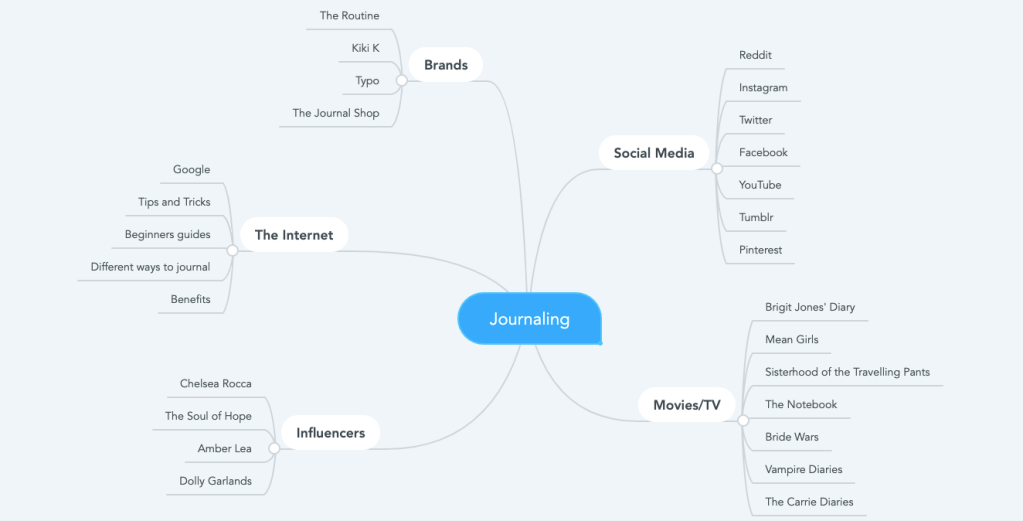
Having my media niche fit into the realm of lifestyle, more specifically wellbeing opens me up to a lot of different ways to approach this subject. Narrowing this down however has been quite easy for me, lately I have been so intrigued by the notion and idea of journaling. When researching into journaling, it feels like a whole new world and perspective on life, both what I like to be seeing. So, through this, I made a mind map connecting journaling to different field sites.

To understand this mind map, I will talk about what a field site is. Basically a field site is not one specific place or thing, it is a range of different places, people, things, sites etc that hold any type of information or connection to a certain niche. Because we are looking at this niche in an ethnographic frame of mind, we must also understand what ethnographic research is. Let’s break it down.

Ethnographic research: “The study of the culture and social organisation of a particular group or community … Ethnography refers to both the data gathering of anthropology and the development of analysis of specific peoples, settings or ways of life.” Studying ethnographically means to truly understand one particular group, community or concept and this then involves participating or observing that specific area. The whole idea of it, is to truly understand a problem and come up with a better solution to fix this. Therefore, with my media niche circulating around journaling, I intend to begin my own personal journaling journey and truly seek its benefits. Are there any? How come they are there? Why is being in touch with your emotions so important to understanding yourself? How does one simple act create such a large impact?

Field Site: This involves anything to do with a certain area of interest. Whether that be people involved, branding, places to find it, media sites, physical and non physical places, products … anything at all. Therefore, as seen above I have narrowed down some field sites connected to journaling. I placed them into headings and branched off more specific from there. These are all places/people/products that I have found since slightly touching on researching further into the spectrum of journaling.

People who might be interested in my niche are people who have similar interests to me, such as lifestyle and wellbeing content. Not only this but people who regularly journal, no matter the form they choose to do this.

I bring a new perspective to this area of study. The reason simply being I haven’t done it before and want to and will learn as I go. I am interested in this aspect of life as I want to better my wellbeing by doing simple things daily, and it appears that journaling has a world of its own. I want to learn about this world, this community and society of people who share a common interest and see what else they have in common. Is there a negative connotation based around keeping a journal?

There are multiple articles stating the benefits of journaling on mental and physical health. These include reducing stress, improving immune functions, memory improvements, mood booster and strengthening emotional functions. This is fascinating to me, how does it help someone so much though? Well, by prioritising your problems, fears and emotions you are allowing yourself to face them properly, understand them and let them go. It also allows room for more positive self talk and that is something that is highly underrated. As our minds are constantly thinking whether we are aware of it or not, it is important that for the most part these thoughts are in a positive mood and attitude.

“Smyth’s team studied 107 people with asthma and rheumatoid arthritis. He asked half the group to write for 20 minutes a day for three days about the most stressful event they could remember. The control group was asked to write about their daily plans. Four months later, 70 people in the group that wrote about their stress showed improvement. Only 37 of the control group improved.”

All in all, furthering research in journaling with an ethnographic approach appears, to me, to be the best way to truly understand this niche and try solve the stigma around ‘keeping a journal is for 12 year old girls’.

Stay True, R.

[Edit 03 September 2020 below]

References

Calhoun, C. J. (2002). Dictionary of the social sciences. New York: Oxford University Press viewed 14 August 2020

Unknown, 2020, ‘Fieldsite’, viewed 14 August 2020 < https://www.yourdictionary.com/fieldsite#:~:text=(plural%20fieldsites),where%20fieldwork%20is%20carried%20out. >

Leo, 2018, ‘The 17 Different Types of Journals that will Keep your Life Organised’, viewed 14 August 2020, < https://www.jofelo.com/17-different-types-of-journals-to-keep/ >

Bailey, K, 2018, 5 Powerful Health Benefits of Journaling, viewed 14 August 2020, < https://intermountainhealthcare.org/blogs/topics/live-well/2018/07/5-powerful-health-benefits-of-journaling/ >

Watson, R, 2020, ‘Journaling for Mental Health’, viewed 14 August 2020, < https://www.urmc.rochester.edu/encyclopedia/content.aspx?ContentID=4552&ContentTypeID=1#:~:text=Journaling%20helps%20control%20your%20symptoms,and%20identifying%20negative%20thoughts%20and >

Hartwell-Walker, M, 2018, ‘Writing for Health, viewed 14 August 2020, < https://psychcentral.com/lib/writing-for-health/ >